


Table of Contents
Standing in the water aisle at 9pm trying to work out whether “purified” and “distilled” are the same thing, and whether either is what the formula can meant. There are six options, three of them cost more than milk, and none of the labels explain themselves.
Here's what actually matters, and it's less than the aisle suggests.
Quick Answer
Distilled water for babies is safe for mixing infant formula. The CDC lists it alongside purified, deionised, and demineralised water as acceptable, and its low fluoride content is why it gets recommended to parents worried about dental fluorosis.
There are 2 big misconceptions people have about this. Distilled water and sterile water are not exactly the same thing, as the FDA makes it a requirement for bottled water labels to clear this up. But here's the thing: for babies under two months, for those that were born premature, and for any little one with a weakened immune system, the water still needs to be heated to 158 degrees Fahrenheit regardless of whether you're using distilled or any other kind of water.
For a healthy full-term baby over two months, safe tap water works fine and is what the AAP generally prefers.
Is Distilled Water Safe for Babies?

Yes, with the caveats above. Worth understanding what the process actually does, because that explains both the benefits and the limits.
What the Distillation Process Removes
Distillation boils water into steam and then turns it back into liquid, letting all those unwanted minerals, salts and heavy metals like lead stay behind in the pot. What you're left with is pretty much pure H2O.
This is actually a great approach if you're worried about lead from old pipes, high mineral levels or naturally occurring fluoride in the water from your well. Distillation does a better job of dealing with all three than a lot of filtering systems can.
Practically, distilled water is easy to find and cheap. Most grocery stores, Target, and Walmart stock it in 1-gallon jugs, usually a dollar or two, shelved with bottled water rather than baby products. Buying it in the baby aisle as “nursery water” typically costs several times more for functionally the same thing, minus the fluoride question.
Why Distilled Water Is Not Necessarily Sterile
Here's the part that catches people out. Distillation removes minerals and chemicals. It doesn't guarantee the bottle stays sterile afterwards.
Now, water, especially bottled water, can pick up bacteria while it's being bottled, and then obviously there's the risk of it getting contaminated after you open the container and leave it sitting out on the counter for a week or so.
The FDA does require water manufacturers to put a warning on the label telling you that it's not sterile, and it’s for all sorts of water, including the ones specifically marketed for babies.
Which matters because parents reasonably assume “distilled” means “safe to use straight from the bottle, cold.” For most babies that's fine. For the high-risk group, it isn't, and the reason has nothing to do with the water.
Why Formula-Fed Babies Still Receive Essential Minerals
The other common worry is that distilled water strips out minerals babies need. It does remove them, but it doesn't matter, because infant formula is fortified to deliver complete nutrition on its own.
Formula manufacturers assume the water contributes essentially nothing nutritionally. Calcium, magnesium, iron, zinc, it's all in the powder, calibrated to meet requirements when mixed with plain water. A baby on formula mixed with distilled water isn't missing anything.
The exception is fluoride, which is a different conversation.
Fluoride-Free Water and Mild Dental Fluorosis
Distilled water for babies contains essentially no fluoride, and that cuts both ways.
Fluoride helps prevent tooth decay, which is why most public water supplies add it. But a baby who consumes only formula reconstituted with fluoridated water may take in more fluoride than a breastfed baby, and the CDC notes this can slightly increase the chance of mild dental fluorosis—faint white markings on the permanent teeth that are usually only visible to a dentist looking closely.
Worth keeping the scale in mind. Fluorosis from optimally fluoridated water is cosmetic, not a disease, and advanced forms are extremely rare even in communities that have fluoridated for fifty years. It's a trade-off, not a hazard.
The AAP's practical position is a middle path: primarily use safe fluoridated tap water, and occasionally use non-fluoridated bottled water. That gets the decay protection without concentrating fluoride intake.
When to Ask a Pediatrician or Pediatric Dentist About Fluoride
If you're using water that's naturally very low in fluoride, or you're getting formula ready for your baby from a ready-to-drink source, or you're on well water without any idea what the fluoride levels are, you might want to raise this with your healthcare provider. In the first two cases a supplement may be suggested; in the third you need a test result before deciding anything.
The American Dental Association's benchmark is water below 0.7 parts per million. Your local water utility publishes its figure, and the CDC maintains a lookup tool for community water systems.
Distilled vs Purified vs Nursery vs Tap vs Well Water
The labels are genuinely confusing, and the differences matter more for some households than others.
Distilled, Purified, and Reverse-Osmosis Water
Distilled is boiled down and condensed, so it’s all that’s left is water. The mineral content is barely nothing, a tiny bit of fluoride, and the CDC has approved it for formula.
Purified covers a bunch of different water treatment methods (distillation, reverse osmosis, deionisation, to name a few). Most of the time, it’s low in fluoride, but you really need to read the label, some companies will put minerals back in to make it taste nicer, and some even add fluoride. And as an added bonus, if they do, the FDA requires it’s to be listed on the tin.
Reverse osmosis is a process that pushes water through a super thin membrane, and that does the trick of removing just about all of the dissolved solids (fluoride and lead included). Not a bad choice for formula. But if you’ve got a home RO system, you do need to remember to change the filters or it just won’t work properly.
In real terms, these three process names are pretty much all the same when it comes to formula, its the label that counts, not the name on it.
Nursery Water: With or Without Added Fluoride
Nursery water (bottled water designed with young infants in mind) comes in two options, one with a splash of fluoride and one without. Check the label rather than the branding.
Also worth knowing that nursery water isn't sterile either, despite the packaging strongly implying otherwise.
Tap Water: Local Safety, Fluoride, and Household Plumbing
For most families with municipal water, tap is fine and it's what the AAP generally prefers, since it delivers fluoride at a level calibrated for dental health.
Two things to check. Your local water quality report, that gets published every year by your utility, and your own plumbing, even though a safe municipal supply can still pick up lead from pipes and fittings inside an older building.
If lead is a possibility, run the cold tap for a couple of minutes before drawing water, and never use hot tap water for formula, since hot water leaches more lead from pipes. Better still, get it tested.
Private Well Water: Testing for Nitrates, Bacteria, and Fluoride
Nitrates from farm runoff can cause a serious condition in young babies called blue baby syndrome, a condition known as methemoglobinemia (in which the bloods oxygen carrying capacity gets knocked). Well water is the category where distilled genuinely earns its place, and the concern isn't hypothetical.
None of that is visible or tasteable. Testing is the only way to know. The AAP recommends regular testing for households on wells, and until you have results, distilled or purified bottled water is the sensible default for formula.
Bottled and Spring Water for Travel and Emergencies
Regular bottled drinking water and spring water are usually fine but should be treated like tap water—boiled before use for formula, since they carry the same non-sterile status without the mineral removal that distillation provides.
During water advisories, main breaks, floods, or hurricanes, the CDC advises using bottled water for formula until local authorities confirm the tap supply is safe again.
Why Boiling Does Not Remove Lead, Nitrates, or Other Chemicals
This one deserves saying plainly because it's a widespread and dangerous misconception.
Boiling kills bacteria. It does nothing whatsoever to chemical contaminants. The CDC's language is direct: water contaminated with harmful chemicals or toxins cannot be made safe by boiling, disinfecting, or filtering.
Worse, boiling actively concentrates them. Some water evaporates, the lead or nitrates stay behind, and what remains is more contaminated than what you started with.
So if your concern is bacteria, boil. If your concern is lead, nitrates, or chemicals, boiling is the wrong tool entirely and you need a different water source.
Water Types Compared
| Water type | Fluoride level | Minerals & heavy metals | Safe for formula | Best for appliances |
|---|---|---|---|---|
| Distilled | Essentially none | Removed, including lead | Yes, CDC-listed | Best choice, minimal scale |
| Purified / reverse osmosis | Very low, check label | Mostly removed | Yes, CDC-listed | Good, similar to distilled |
| Fluoridated tap | ~0.7 ppm optimal | Present, may pick up lead from older plumbing | Yes, if locally safe | Poor, causes scale and mineral dust |
| Private well | Varies widely, untested | May contain nitrates, bacteria, natural fluoride | Only after testing | Poor, usually high mineral content |
How to Mix Baby Formula With Distilled Water

The mechanics matter more than the water choice for most families.
Confirm the Water and Formula Are Safe to Use
Check the water label for added fluoride and for the non-sterile statement. Check the formula can for damage, dents, or an expired date, and check it against current FDA recall listings if you've had it a while.
So, before you feed your little one a drop, make sure to wash your hands, give your prep area a good clean and only grab clean bottles and nipples. And if you've got a tiny tot under 3 months, a premature baby or one with a compromised immune system, toss that equipment in a sterilizer and do it again every day.
Do You Need to Boil Distilled Water?
For a healthy, full-term baby over two months: generally no. Distilled and purified water can be used without boiling, which is one of the main practical reasons parents choose it.
For everyone else, the answer changes completely, and it's worth understanding why.
Extra Precautions for Babies Under 2 Months, Premature Babies, and Immunocompromised Babies
The risk here isn't the water. It's the powder.
Powdered infant formula is not a sterile product, and it can't be made one without destroying the nutrients. It occasionally contains Cronobacter sakazakii, a bacterium that causes sepsis and meningitis in newborns. Cases are rare—roughly 18 a year in the US—but mortality in infected infants runs as high as 80%.
That's why the CDC recommends extra precautions for three groups: babies under two months, babies born prematurely, and babies with weakened immune systems. Note that this applies regardless of which water you use. Distilled water doesn't exempt you, because the bacteria aren't in the water.
Use About 158°F (70°C) Water When CDC Extra Precautions Apply
The number matters. 70°C, or 158°F, is the temperature at which Cronobacter is reliably inactivated within seconds. Below it, the bacteria can survive and then multiply as the bottle cools.
The CDC's method is to boil the water and wait about five minutes before mixing. WHO guidance says the same in different words: rolling boil, cool for no more than thirty minutes so it stays above 70°C, then mix.
Too hot is also a problem, since excessive heat degrades some nutrients in the formula. Five minutes after boiling is the window that balances both.
After mixing, the formula will be too hot to feed. Cool it under running cold water, then test a few drops on the inside of your wrist. Warm, not hot.
A Note on Formula Preparation Machines
Automatic formula makers are genuinely useful, and there's a caveat worth knowing before you rely on one.
A 2023 study looked at what 200 UK parents were actually getting out of those machines. Of the 200 machines that got put to the test, only a mere 14.9% managed to dispense water at or near the 70°C mark thats generally recommended, which is roughly the same level of hot water that turns up in 78.3% of kettles being used by parents.
On average, the machines came up about 9°C short of the mark, and that’s a big difference. Cornell university researchers weighed in with a study of their own in 2025, published in the Journal of Food Protection, and expressed concerns about the kind of guidance being given for making up these formula mixes.
For a healthy full-term baby over two months, where hot-water preparation isn't required, a formula machine solves a different and very real problem: scoop-counting errors at 3am. Miscounting is common when you're half-asleep, and over-diluting carries real consequences. The Grownsy Automatic Formula Dispenser handles measuring and mixing consistently, removing that error entirely and getting a bottle ready in under a minute.
If your baby is under two months, was born prematurely, or is immunocompromised, use the boil-and-wait method regardless of what appliance you own, unless the manufacturer publishes a verified dispensing temperature at or above 158°F. That's the specific group the CDC guidance exists for.
Measure the Water First, Then Add the Formula
Water into the bottle first, then the powder. Doing it the other way round changes the final volume and throws off the ratio.
Use the scoop that came with the tin, since scoop sizes differ between brands. Level scoops, not heaped. Follow the label's ratio exactly.
Never, ever think about watering down that formula. We all know what happens when people get desperate, or when they’re coming under pressure to make the money go further. And the AAP has been vocal about how bad an idea this is. Adding extra water is just asking for trouble: it can send sodium levels through the floor, which can cause your little one to seize up. And in extreme cases, it’s even been known to be fatal.
To top it all off, it’s also going to leave the baby underfed. If you are worried about the cost, here’s the thing, there are programs like WIC and formula assistance that’s out there to help.
Cool Safely, Never Microwave, and Store Within Time Limits
Never microwave formula. It heats unevenly and creates hot spots that scald a baby's mouth even when the bottle feels fine on the outside. Cool under running water or in a bowl of cold water instead.
CDC storage limits are strict and worth memorising. Use prepared formula within two hours of preparation, and within one hour of the start of a feeding. If your baby doesn't finish a bottle, throw the rest away, bacteria from their mouth get into the milk. If you're not feeding immediately, refrigerate straight away and use within 24 hours.
Opened distilled water follows its own label, generally refrigerated after opening and used within a few days. Don't decant into a jug that lives on the counter, and don't let the bottle rim touch anything.
Distilled Water for Babies by Age

The water question changes as your baby grows, and the age boundaries are firmer than people expect.
Newborn to 6 Months: No Plain Water Unless Medically Directed
Babies under six months should not be given plain water, distilled or otherwise, unless a pediatrician specifically directs it.
Their kidneys can't handle the fluid load, and water dilutes the sodium in their blood, causing water intoxication. Symptoms include irritability, drowsiness, low body temperature, and facial swelling, and it can progress to seizures. Breast milk or properly mixed formula provides all the hydration a baby this age needs, including in hot weather.
This applies to sips, top-ups, and small amounts offered between feeds. Not a small-quantities-are-fine situation.
6–12 Months: Small Amounts of Water With Solid Foods
Once solids start coming into the picture, small amounts of water alongside meals are okay (anywhere from 4 to 8 ounces a day is fine). The real goal is to get your baby used to using a cup. Let's be real, milk still takes care of hydration, so they don't need extra water.
Tap water is just fine as is distilled water, just make sure it's safe to drink. And as an added bonus, tap water even has some fluoride, which is great for little ones while their teeth are developing.
12 Months and Older: Water as Part of Daily Fluid Intake
After the first birthday water becomes a normal part of the day, roughly one to four cups depending on age, activity, and climate.
At this stage the fluoride question tips toward tap water, since permanent teeth are forming and the decay protection matters. If you're on well water or exclusively using distilled, this is a good point to ask a pediatric dentist about supplementation.
Hot Weather, Constipation, and Why Formula Should Never Be Diluted
There are two situations where parents often get tempted to add water to their baby's diet and the answer is the same in both cases.
When it's super hot outside, don't reach for extra water for your under six month old. Instead, offer more frequent feeds, and a note that breast milk and formula are already pretty high in water, so just adjust to what your baby needs.
When your baby is constipated, sadly adding water isn't the solution. In fact, it can even put them at risk for over-hydration, so try not to do it. If it's a problem, talk to your pediatrician, they may have some specific advice like a certain juice to try or a formula change depending on your baby's age.
Using Distilled Water in Infant Cereal and Homemade Baby Food
Fine, and the same rules apply. Whatever water you'd use for formula, use for mixing cereal or thinning purees. For high-risk infants under two months the hot-water precaution carries over, though most babies are past that window by the time solids start.
Distilled Water for Humidifiers and Baby Feeding Equipment
Outside of drinking, distilled water earns its keep in appliances, and for a completely different reason.
Humidifiers: Reducing Mineral Dust and Scale
This is where distilled water is most clearly worth buying.
Tap water minerals get aerosolized by ultrasonic and cool-mist humidifiers and settle as fine white dust across the nursery, which a baby then breathes. Manufacturers routinely specify distilled water for this reason, and it also prevents scale build-up that shortens the unit's life.
If you run a humidifier in a nursery, distilled water is a genuine upgrade rather than a marginal one.
Sterilizers, Bottle Washers, and Formula Machines
Steam sterilizers, bottle washers, warmers, and formula machines all work by heating water, and that's where tap water causes trouble over time.
The mechanism is straightforward. Tap water carries dissolved calcium and magnesium. When it heats, those minerals come out of solution and deposit on whatever surface is hottest, which is the heating element. Over months this builds into a chalky white or brownish crust. Scale insulates the element, so the appliance runs longer to reach the same temperature and heating becomes uneven. In machines with thermostat sensors, a scaled-over sensor can misread the actual water temperature and either cut off early or throw an error code.
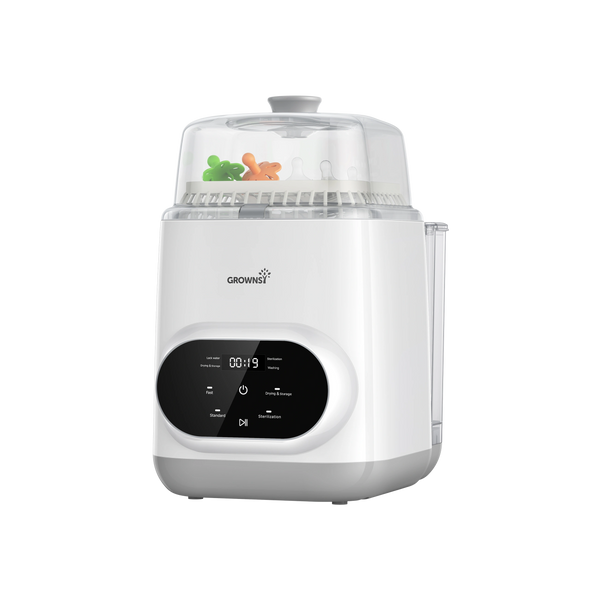
For a bottle warmer or formula machine, uneven heating isn't just inconvenient. It's the gap between the temperature the display claims and what your baby's bottle actually reaches.
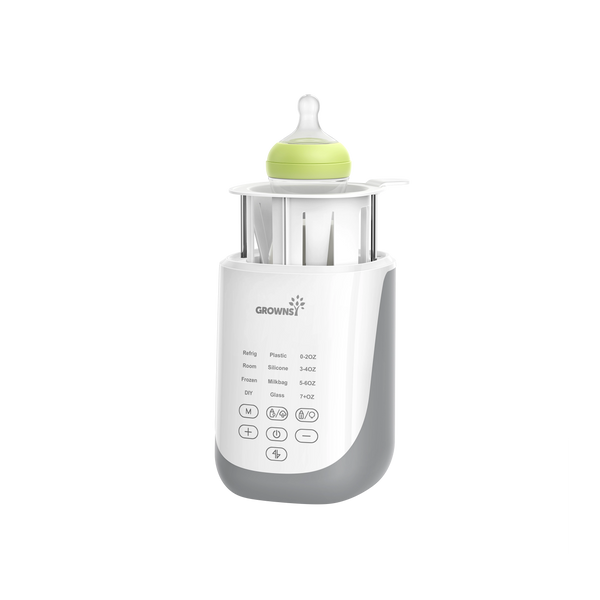
Distilled water largely prevents this, since there's nothing in it to deposit. Hard water areas see the difference fastest.
Pro tip if you've been using tap water: Descale with a 1:1 mix of white vinegar and water. Fill the reservoir, let it sit 30 minutes to an hour depending on buildup, then run a cycle if the appliance has one. Rinse thoroughly two or three times with clean water afterward, because vinegar residue tastes awful and you don't want it in a bottle. Monthly in hard water areas, every few months in soft. Check the manual first, since a few manufacturers specify their own descaling solution and vinegar can void the warranty.
And distilled water reduces scale, it doesn't clean the appliance. Reservoirs still need emptying and drying between uses, filters still need replacing on schedule. Standing water grows biofilm regardless of how pure it started out.
When Safe Tap Water Is Enough
For everyday washing of bottles, nipples, and pacifiers, safe tap water and detergent is entirely sufficient. There's no benefit to distilled water for hand-washing feeding equipment, and buying it for that purpose is money you don't need to spend.
Baby Water Safety Checklist

Five things worth confirming regarding distilled water for babies, and none of them take long.
- Verify the water source and fluoride labelling. You need to check that the water has had fluoride added to it and that the label says “non-sterile.”
- Check for advisories and product recalls. Have a look at your local water report every year and check the FDA website if you bought formula some time ago, and it's still sitting in your cupboard.
- Follow the mixing instructions to the letter. Water first, level scoops of formula, never water down the mix, this is the one thing you could mess up with potentially serious consequences.
- Keep the bottle clean after opening it. Stick it in the fridge as per the label, don’t transfer it to an open container & keep the rim squeaky clean.
- Get medical advice for babies who are particularly vulnerable to illness. If your baby is under two months, premature, or has a weak immune system, they don’t apply to the standard advice even if it’s plastered all over the internet. Talk to your pediatrician instead.
Conclusion
Distilled water for babies is safe, CDC-approved for formula, and genuinely useful if you're on well water, have older plumbing, or want to limit fluoride intake. It's also the right choice for humidifiers, where mineral dust is a real consideration.
But it's not sterile (water never is) and it’s also not a free pass to skip the whole hot-water-precaution thing if your baby is under two months old, or premature, or has some other health issue that makes them more vulnerable. The thing is, the hot-water precaution is there to stop bacteria in the formula powder from causing a problem, not the water. So, no matter what type of water you choose, that precaution is still necessary.
For most families with a healthy full-term baby and safe municipal water, tap is fine and the AAP prefers it. The water aisle is more complicated than the decision needs to be.
References
- Centers for Disease Control and Prevention. Infant Formula Preparation and Storage. Last reviewed May 2026. https://www.cdc.gov/infant-toddler-nutrition/formula-feeding/preparation-and-storage.html
- American Academy of Pediatrics, HealthyChildren.org. How to Safely Prepare Baby Formula With Water. https://www.healthychildren.org/English/ages-stages/baby/formula-feeding/Pages/how-to-safely-prepare-formula-with-water.aspx
- Mayo Clinic. Infant Formula: 7 Steps to Prepare It Safely. https://www.mayoclinic.org/healthy-lifestyle/infant-and-toddler-health/in-depth/infant-formula/art-20045791
- U.S. Food and Drug Administration. Help Prevent Cronobacter Illness: Prepare and Store Powdered Infant Formula Safely. https://www.fda.gov/media/158904/download
- National Institutes of Health, PMC. The safety of at home powdered infant formula preparation: A community science project. https://www.ncbi.nlm.nih.gov/pmc/articles/PMC10750023/
- Cornell University. Improving guidelines can help combat deadly bacteria in powdered baby formula. Journal of Food Protection, 2025. https://news.cornell.edu/stories/2025/08/improving-guidelines-can-help-combat-deadly-bacteria-powdered-baby-formula
- National Institutes of Health, PMC. Infant burn injuries related to water heating for powdered infant formula preparation. https://www.ncbi.nlm.nih.gov/pmc/articles/PMC10192855/
- New York State Department of Health. Guidance for Use of Fluoridated Water for Feeding During Infancy. https://www.health.ny.gov/prevention/dental/fluoride_guidance_during_infancy.htm
- U.S. Environmental Protection Agency. Protect Your Home's Water. https://www.epa.gov/privatewells/protect-your-homes-water
Disclaimer
This article is for informational purposes only and is not a substitute for professional medical advice. If your baby is under two months old, was born prematurely, or has a weakened immune system, follow your pediatrician's specific instructions on formula preparation. Never give plain water to a baby under six months unless directed by a healthcare professional.


