


It's the end of a long feeding day. There are bottles in the sink, nipples and caps scattered across the counter, and the dishwasher still has a load of dinner dishes waiting to be run. You know the bottles need to be cleaned but do they really need their own appliance?
For many parents, this is where the bottle washer vs. dishwasher question comes up.
A dishwasher can absolutely clean baby bottles when they are dishwasher-safe. But a dedicated bottle washer is designed around a different routine: frequent bottle cleaning, smaller loads, pump parts, sterilizing, drying, and storage. Instead of asking which appliance is simply "better," the more useful question is which one fits your family's daily feeding routine better.
Bottle Washer vs. Dishwasher at a Glance
| Factor | Baby Bottle Washer | Dishwasher |
|---|---|---|
| Designed specifically for baby feeding items | Yes | No |
| Washes baby bottles | Yes | Yes, if dishwasher-safe |
| Targeted spray coverage | Designed around bottle parts | General dishwasher spray pattern |
| Sterilizing function | Available on some models | Depends on model and cycle |
| Heated drying | Yes, depending on model | Depends on model and cycle |
| Dedicated bottle storage | Available on some models | No |
| Small bottle loads | Convenient | Usually less practical |
| Household dishes | No | Yes |
| Best for | Frequent bottle-cleaning routines | Families already using a dishwasher |
The key difference is simple: a dishwasher is a general-purpose appliance, while a bottle washer is designed around the repeated cleaning needs of baby feeding equipment.
Can You Wash Baby Bottles in a Dishwasher?
Yes---if the bottles and their components are dishwasher-safe.
The CDC recommends taking infant feeding items apart before placing them in a dishwasher. Small components should be secured in a closed-top basket or mesh bag, and using hot water with heated drying or a sanitizing setting can provide an additional sanitizing step. (CDC)
So the question isn't really whether a dishwasher can clean baby bottles. It can.
The more useful question is: Is a dishwasher the most convenient way to manage bottles every day?
For some families, yes. For others, a dedicated bottle washer can make more sense.
Bottle Washer vs. Dishwasher: What's the Difference?
1. A Bottle Washer Is Dedicated to Baby Feeding Items
A dishwasher is built to handle everything from plates and glasses to cookware. A bottle washer is designed specifically around baby feeding equipment.
That difference matters when bottles are being cleaned several times a day.
With a dishwasher, you may need to wait for enough dishes to accumulate before running a cycle. You also have to separate bottle parts from other dishes and secure smaller components properly.
A dedicated bottle washer can be used whenever your bottles need cleaning, without waiting for a full household load.
A bottle washer may be especially useful if you:
- Use several bottles every day
- Formula-feed or combination-feed
- Pump frequently
- Clean bottles and pump parts multiple times a day
- Prefer to keep baby feeding equipment separate
- Want a dedicated cleaning routine
2. Bottle Washers Can Provide Targeted Cleaning
Baby bottles include more than the bottle body. A typical feeding setup can contain nipples, rings, caps, valves, vents, and other small components.
The CDC recommends completely disassembling feeding equipment before cleaning so all surfaces can be thoroughly cleaned. (CDC)
A dedicated bottle washer is designed around this type of equipment rather than a mixture of household dishes.
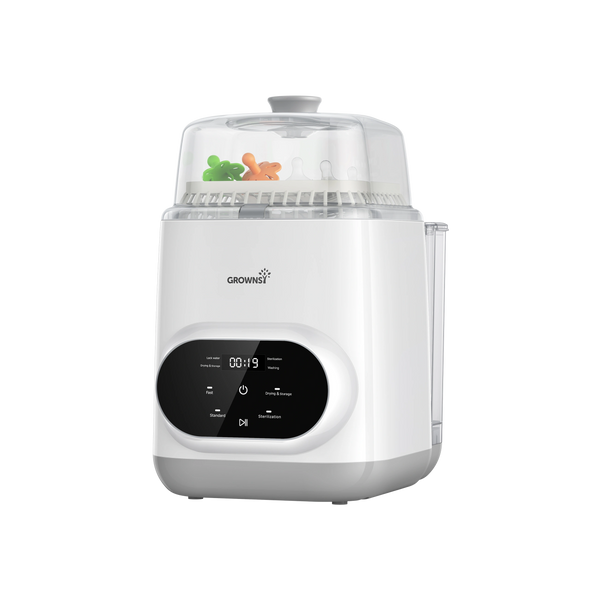
For example, the Grownsy Bottle Washer uses 26 spray jets and up to 24,000 Pa of water pressure to direct water around bottle components during washing.
The difference isn't that a dishwasher cannot clean bottles. It's that a bottle washer is designed specifically around the job.
3. Bottle Washer vs. Dishwasher for Small Loads
Imagine you have four dirty bottles after a day of feeding.
With a dishwasher, you may need to:
- Add the bottles to the next household load, or
- Run the dishwasher mainly for the bottles.
A bottle washer is designed for this type of smaller, repeated load. You can clean bottles when needed instead of coordinating bottle cleaning with your household dishwashing schedule.
This can be particularly useful during the newborn stage, when feeding equipment may need to be cleaned repeatedly throughout the day.
4. What About Sterilizing Baby Bottles?
This depends on the appliance.
A dishwasher may have a heated drying or sanitizing setting, but functions vary by model. The CDC notes that a dishwasher using hot water together with heated drying or a sanitizing setting can provide sufficient sanitizing for infant feeding items. (CDC)
A bottle washer with a dedicated sterilizing function can combine cleaning and sanitizing in one appliance.
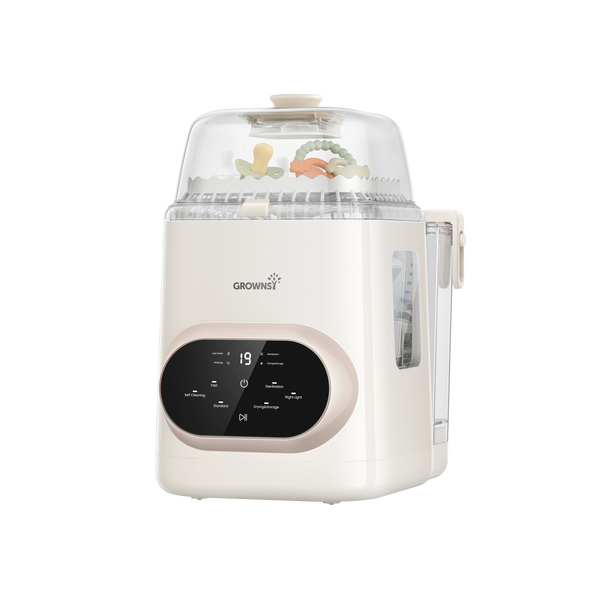
Grownsy's 4-in-1 bottle washer combines:
Wash → Sterilize → Dry → Store
This means parents can complete multiple stages without moving bottles between appliances.
It's important to distinguish cleaning from sanitizing: washing removes milk and formula residue, while sanitizing is an additional step intended to reduce germs. The appropriate routine depends on factors such as the baby's age, health, and healthcare guidance. (CDC)
5. Drying Is Part of the Routine
Cleaning is only part of bottle care. Bottles and components should be completely dry before storage or reuse.
The CDC recommends allowing cleaned feeding items to air-dry completely and storing them in a clean place once dry. (CDC)
A dishwasher may provide heated drying, depending on the model. A bottle washer with an integrated drying cycle can make drying part of the same workflow.
Grownsy combines washing, sterilizing, and drying, with a 60-minute Dry & Storage cycle designed to take bottles from cleaning through drying and storage.
6. Bottle Washer vs. Dishwasher for Storage
A dishwasher cleans dishes but generally isn't designed to serve as dedicated storage for clean baby bottles.
After a dishwasher cycle, parents typically need to remove the feeding items and transfer them to a clean, dry storage area.
Some bottle washers continue from drying into storage. Grownsy provides up to 72 hours of sterile storage, allowing cleaned and dried feeding items to remain inside the appliance until needed.
This creates a more continuous workflow:
Wash → Sterilize → Dry → Store → Use
For parents who clean bottles several times a day, reducing extra handling steps can make the routine easier to manage.
7. What About Breast Pump Parts?
Breast pump equipment can contain multiple small components, including valves and membranes. The CDC recommends taking pump equipment apart after use so it can be thoroughly cleaned. (CDC)
Whether pump parts can go into a dishwasher or bottle washer depends on the manufacturer's instructions.
Always check the pump manufacturer's cleaning and dishwasher-safety instructions before putting pump parts into any appliance.
If compatible, a bottle washer can potentially handle both bottles and other feeding components in the same routine.
Is a Bottle Washer Better Than a Dishwasher?
Not necessarily.
A dishwasher can be an excellent option for families whose bottles are dishwasher-safe and who already have an efficient dishwasher routine.
A bottle washer becomes more compelling when baby feeding equipment itself is the main cleaning workload.
Choose a dishwasher if:
- Your bottles and parts are dishwasher-safe.
- You already run the dishwasher frequently.
- You don't mind waiting for a full load.
- You are comfortable securing small bottle components.
- You don't need a dedicated bottle-cleaning appliance.
Consider a bottle washer if:
- You wash bottles several times a day.
- You regularly clean multiple bottles at once.
- You also clean compatible breast pump parts.
- You want a dedicated appliance for baby feeding equipment.
- You want washing, sterilizing, drying, and storage in one workflow.
- You want to run smaller bottle loads without waiting for a dishwasher cycle.
Bottle Washer vs. Dishwasher: Which Saves More Time?
It depends on your routine.
A dishwasher can save time by cleaning bottles with your other dishes, but you still need to disassemble the bottles, load the parts correctly, wait for the cycle, remove the clean items, and store them.
A dedicated bottle washer is designed to reduce the number of separate steps involved in bottle care.
Grownsy offers a 19-minute Quick Wash and a 29-minute Standard Wash, followed by dedicated sterilizing, drying, and storage functions.
For parents who clean bottles frequently, the biggest benefit isn't necessarily that one appliance is universally faster. It's that bottle cleaning no longer has to compete with the household dishwashing routine.
Bottle Washer vs. Dishwasher: Which Is Right for Your Family?
There isn't one answer for every family.
A dishwasher may be enough if:
You already have a dishwasher, your bottles are dishwasher-safe, and you don't mind including bottle parts in your normal dishwashing routine.
A bottle washer may be worth considering if:
You wash bottles frequently and want to simplify the entire process rather than automate only the washing step.
The biggest difference is therefore the workflow.
A dishwasher is a general-purpose kitchen appliance that can clean baby bottles.
A bottle washer is a dedicated baby-feeding appliance designed to make bottle care a repeatable, contained routine.
Bottom Line: Bottle Washer vs. Dishwasher
Can you wash baby bottles in a dishwasher? Yes, if the bottles and components are dishwasher-safe and you follow the manufacturer's instructions. The CDC provides specific guidance for disassembling, loading, and drying infant feeding items in a dishwasher. (CDC)
Is a dishwasher enough? For many families, yes.
When does a bottle washer make more sense? When bottles and feeding parts are cleaned frequently and you want a dedicated system that combines multiple steps.
What is the main advantage of a bottle washer? It can turn a multi-step routine into a dedicated workflow---wash, sterilize, dry, and store---without waiting for the household dishwasher to be ready.
For parents who clean several bottles every day, that difference can make bottle care feel less like another household chore and more like a routine that simply runs in the background.
Frequently Asked Questions
Can I wash baby bottles in the dishwasher?
Yes, if the bottles and their components are labeled dishwasher-safe. The CDC recommends taking bottles apart, placing small parts in a closed-top basket or mesh bag, and using a hot-water cycle with heated drying or a sanitizing setting when available. (CDC)
Is a bottle washer better than a dishwasher?
Neither is universally better. A dishwasher is more versatile for household dishes, while a bottle washer is designed specifically around frequent cleaning of baby bottles and feeding equipment.
Do I need a bottle washer if I have a dishwasher?
Not necessarily. If your dishwasher is already part of an efficient bottle-cleaning routine, you may not need one. A bottle washer can be useful if you frequently wash small loads of bottles or want integrated sterilizing, drying, and storage.
Can a bottle washer replace a dishwasher?
No. A bottle washer is designed for baby bottles and compatible feeding equipment, while a dishwasher is a general-purpose appliance for household dishes.
Do baby bottles need to be sterilized after every use?
Not necessarily for every healthy, older infant. The CDC recommends extra sanitizing in certain situations, including for babies younger than 2 months, babies born prematurely, or babies with weakened immune systems. Always follow your baby's healthcare provider's advice and the manufacturer's instructions for your feeding equipment. (CDC)
Should baby bottles be completely dry before storage?
Yes. The CDC recommends allowing cleaned feeding items to air-dry completely before storing them in a clean place. (CDC)
Can I put breast pump parts in a bottle washer?
Only if the specific pump components are approved for that cleaning method. Always check the pump manufacturer's instructions before using a bottle washer or dishwasher.


