


Every parent knows the heart-wrenching feeling of listening to their baby struggle through a stuffy nose. Whether it’s that subtle, raspy sound during midnight feedings or the fussy restlessness that keeps the whole house awake, baby nasal congestion can make you feel completely helpless.
If you are currently holding a fussy little one and wondering how to help a congested baby breathe easier, take a deep breath—you are not alone, and you are doing a great job.
Medical Review & Expert Advice
To give you the safest, most effective guidance, we teamed up with Dr. Molly O’Shea, MD, FAAP (Board-Certified Pediatrician and Fellow of the American Academy of Pediatrics). Together, we’ve broken down everything you need to know about baby congestion relief—from understanding why their tiny noses get so noisy to creating a gentle, pediatrician-approved routine that actually works.
1. Why Baby Nasal Congestion Affects Feeding, Comfort, and Sleep
As Dr. O'Shea points out, babies are obligate nasal breathers—meaning they naturally rely on their tiny noses to breathe, especially during their first few months. Because their nasal passages are so small, even a tiny bit of swelling or sticky mucus can disrupt their entire routine.
- Feeding Struggles: Imagine trying to drink a bottle while holding your breath! Because infants must breathe through their nose while nursing or bottle-feeding, a blocked nose makes it almost impossible to latch or swallow comfortably.
- Sleep Disruption: Lying flat naturally causes fluid to pool and nasal tissue to swell, leading to a baby stuffy nose at night. Mucus drainage also triggers ticklish coughs, making uninterrupted sleep a challenge for both baby and parents.
- Infant Reflux & Noisy Breathing: Almost all healthy infants experience mild acid reflux. When stomach contents slosh back up the esophagus, they can irritate the delicate lining of the nose. The nose responds by producing extra mucus to protect itself.
Why does my baby sound congested but no mucus comes out?
If your baby sounds congested but no mucus in nose is visible, don't worry—it’s very common! Tissue inflammation or subtle reflux irritation can cause noisy breathing even without excess snot. Dry indoor air can also swell delicate nasal tissues, making your baby sound congested without any actual liquid buildup.
Featured All product Baby Nursery Essentials

2. Should You Use Saline Spray for Babies Before Suctioning?
Yes, absolutely. As Dr. O'Shea emphasizes, "softening before suctioning" is the key to a gentle experience.
When mucus sits in tiny nostrils, the body reabsorbs its moisture, turning it into thick, sticky buildup. Suctioning dry snot directly can pull on sensitive nasal membranes, causing irritation that actually triggers more mucus production.
Using a gentle saline spray for babies or an infant saline spray before suctioning offers critical benefits:
- Rehydrates and breaks down stubborn, sticky snot.
- Loosens blockages so they glide out effortlessly.
- Allows you to use the absolute lowest suction setting, keeping the experience comfortable and tear-free.
3. The 3-Step Routine for Baby Congestion Relief: Spray → Suction → Soothe
Instead of struggling with a single bulb syringe, following a structured spray → suction → soothe routine delivers comprehensive relief while protecting your baby's delicate nose.
- STEP 1 - SPRAY: Apply a quick mist of children's saline nasal spray or saline drops to moisten and break down dry, sticky mucus.
- STEP 2 - SUCTION: Gently clear the nasal passage using a gentle aspirator on the lowest effective setting.
- STEP 3 - SOOTHE : Finish with a light saline mist. This final hydration step calms irritated tissue so the nose doesn't overproduce mucus immediately while creating an environment that repels germs.
Maintaining saline moisture creates an environment hostile to viral germs—studies show using saline regularly during a cold can shorten viral symptoms by up to 2 days!
4. How to Choose a Gentle Nasal Aspirator at Home
When shopping for baby congestion medicine alternatives at home, over-the-counter cold medications are strictly off-limits for infants. Instead, a well-designed nasal aspirator is your safest tool. Look for these essential features:
- Adjustable Suction Levels: Traditional bulb syringes offer unpredictable suction strength. Choosing a device with multiple adjustable levels ensures you always use the gentlest pressure needed.
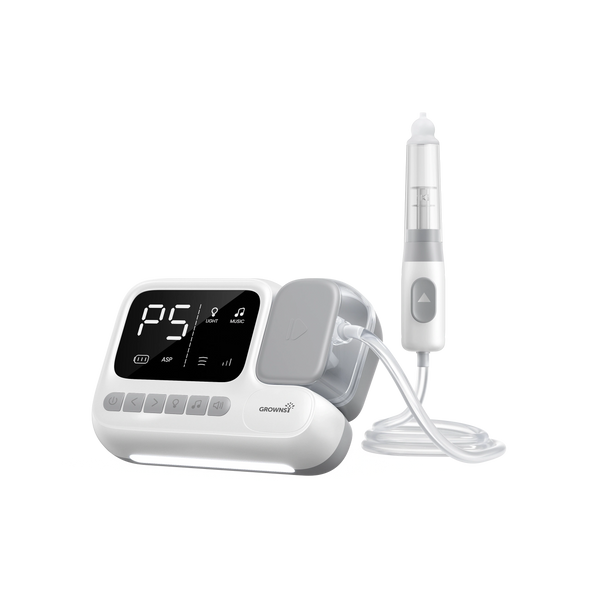
- All-in-One Hydration: Multi-functional tools—like the Grownsy Sniffease Spa—integrate pre-suction spray, gentle suction, and post-suction misting into a single device. This is especially life-changing for fussy babies or premature infants with extra-sensitive nostrils.
-
Easy to Clean: Ensure all components disassemble easily to keep things sanitary for every use.
5. Safe Sleep Practices & When to Consult Your Pediatrician
It's completely natural for parents to worry: Is it ok to let baby sleep with a stuffy nose, and can babies die from a stuffy nose?
While severe respiratory distress always requires immediate medical care, a simple baby stuffy nose from a mild cold is very common. However, never alter safe sleep environments to treat congestion. The best sleeping position for baby with stuffy nose is always flat on their back on a firm, flat mattress. Never use inclined pillows, wedges, or soft rolled towels, as these increase the risk of suffocation and SIDS.
| Gentle Care at Home | When to Call Your Pediatrician |
|---|---|
|
|


