Table of Contents
When Do Babies Start Cooing and Babbling? A Complete Sound-by-Sound Guide
It’s every parent’s dream to hear their baby’s first words… but it takes time to build up to that. And that build-up? It comes in forms of cooing and babbling that awes you with cuteness. All these sounds, from growls to whispers, are incredible wins too!
It’s no surprise if you’re curious about the precise moments each of these milestones is achieved, It’s awesomely thrilling to hear the “coo~” or the “ba!” they first share with you.
These early sound explorations are fundamental building blocks. Despite them sounding like gibberish, they’re actually the product of a ton of effort by the baby in coordinating their tongue, lips, and vocal chords.
So why not honor that effort? Let’s learn more about when do babies start cooing, babbling, and discovering their voices.

Your Baby's First-Year Sound Journey
The path to your baby's first real words is a gradual transformation. Long, long before they say “mama” or "dada," they explore how to speak using a variety of pre-speech noises. While every baby develops at their own pace, pediatric experts note that most infants follow a predictable path as they discover how to use their vocal tract.
What Is Cooing and Why It Comes First
Before babies can master the tricky tongue and lip movements needed to form complex consonant sounds, they begin with something much simpler: pure, open vowels. This delightful stage is known as cooing. Baby cooing sounds typically consist of soft, musical, elongated vowel sounds like “ooo,” “aaa,” and “eee.”
Why does it happen first? It is largely a matter of anatomy. In their early months, a baby’s oral cavity is quite small, and their tongue sits relatively far forward. As throat muscles strengthen and the vocal tract grows, they naturally discover that passing air through their larynx while shaping their mouth creates these sweet, soothing tones.
When Do Babies Start Cooing?
Babies usually start experimenting with cooing by around 2 months, according to American Academy of Pediatrics.
However, speech-language research suggests that some eager early birds might start testing out these soft, elongated vowel sounds as early as 6 weeks, while other perfectly healthy infants take their time, truly warming up to the habit closer to 3 months.
During this special phase, you will likely notice that your baby is most vocal when they are feeling content, calm, and deeply comfortable—often right after a satisfying feeding or while staring up at your smiling face.
What Is Babbling — and How Is It Different from Cooing?
As your infant grows, their vocal play evolves from soft, continuous vowel flows into something far more structured. This is where babbling takes center stage. The main difference between the two is the addition of consonant sounds.
Babbling involves the complete (and active) closure of the lips and tongue against the teeth or palate, whereas cooing is solely vowel-driven ("ooo"). This helps them make them more distinct, rhythmic syllables like "ba," "da," "ma," or "ga".
Babbling is a big advancement in your child's cognitive and physical development because it takes a lot more muscle control and coordination than cooing.
When Do Babies Start Babbling?
When do babies start babbling honestly depends — mostly on individual development — but based on speech-language research, most go through five major babbling stages through the first year of infancy.
-
Stage 1: Reflexive Sounds (0–2 months)
An infant's first noises are completely automatic and physical, according to the American Academy of Pediatrics. These include little vegetative sounds like grunting, sneezing, coughing, and burping, as well as weeping to convey hunger or discomfort.

-
Stage 3: Vocal Play and Exploration (4–6 months)
This is the start of experimentation. With the baby getting more control over their vocals, they start changing pitch, loudness, friction. It’s amazing how much fun they have just making sounds! You’ll probably hear everything from dramatic, high-pitched squeals to wet, bubbly raspberries.

-
Stage 4: Reduplicated Babbling (6-9 months)
A lot of experts say that this is the canonical babbling stage. A lot of babies use this time frame to start repeating the same consonant-vowel syllable repeatedly. These rhythmic chains generally start with "ba-ba-ba," "ma-ma-ma," or "da-da-da."

-
Stage 5: Variegated Babbling and Jargon (9-12+ months)
This is the most advanced stage of the lot here, and a lot of research notes that it’s at this point that infants begin to blend consonants and vowels together! Instead of simple repetitions, they might even start to say "ba-da-ma-ga."
Eventually, this will turn into jargon — AKA longer, more complex strings of syllables that children learn to deliver with intonation, rhythm, and emphasis. It’s like their own secret language!
My Baby Stopped Cooing — Is That Normal?
It can be startling when your baby, who was chattering happily last week, suddenly goes quiet. In most cases, speech-language research suggests a temporary pause in vocalizing is completely normal.
When an infant is working hard to master a new physical milestone — rolling over, sitting up, or crawling — their brain temporarily shifts focus away from verbal practice. After they master that new ability, their happy talk usually resumes with a vengeance, frequently incorporating new noises.
Do Squeals, Growls, and Raspberries Count As Babbling?
Of course. You might think they’re just messy (but funny) habits, but research puts them in a group of vital components of the “vocal play” stage of early communication.
- Squeals and Growls: Your baby is actively exploring with vocal cord tension and testing the upper and lower boundaries of their pitch when they let out a sharp squeal or a humorous, deep growl.
- Raspberries: Vibrating their lips and blowing spit bubbles help them develop critical awareness and control over their mouth muscles, which are vital skills for later pronouncing letters like P, B, M, and F.
Do Babbles Actually Mean Something?
In the very beginning, your baby’s reduplicated babbles—like “da-da-da” or “ma-ma-ma”—are pure physical exploration. They are not yet attaching meaning to the sounds; they simply love the vibration against their lips and tongue.
But when you communicate with them consistently, responding to their babbling, they start shifting the aimlessness of their babbling into deliberate communication, and specific sounds start to have real-world importance.
Take, for example, the baby’s father. Point at their father, smile, and clap when they say “da-da” and, over time, they’ll come to associate the word with their father, giving meaning to the language.
The Special Cases
While it’s true that each baby does develop according to their own schedule, it’s also true that external environments and other factors affect their growth and milestones. This is especially so in three very special cases:
- Premies (Premature-Born Babies): When you’re measuring their development, you should use their adjusted age rather than the chronological one, since speech-language research has proven that their timeline needs extra grace to match their physical maturation.
- Multiples (Twins and Triplets): It’s common for twins to babble later on because they understand each other so well they feel less pressure to use vocalizations and language.
- Bilingual Households: Research shows bilingual babies can take a bit longer to sort through two sets of speech patterns and can even babble with a diverse range of sounds as they learn both systems.
How to Encourage Cooing and Babbling
You’re your baby’s favorite conversational partner, and your daily interactions play a major role in shaping their language skills. Here are several fun ways:
1: Interact with Your Baby Frequently… and Pause for a Reply
Treat your baby’s vocalizations like a real, two-way conversation. Respond immediately when they make a sound, then leave a deliberate pause. That expectant look teaches them the golden rule of communication: turn-taking.
2: Imitate Their Sounds (Even If You Think It’s Silly)
When your child makes a joyful "coo" or a proud "ba," mimic the sound exactly. This doesn’t seem like a lot, but it actually creates a positive feedback loop! It shows your baby that their vocalizations are important, and they get motivated to try out more and more sounds.
3: Get Face-to-Face: Eye Contact Triggers More Vocalizing
Get your face close to theirs, within 8 to 12 inches, during the early months. Infants learn to speak by watching the movement of your mouth, lips, and tongue, so your expressions are their best visual guide.
4: Sing, Read and Narrate Your Day
Turn your daily routine into a live broadcast. Narrate bath time, laundry, cooking. Read picture books, point to illustrations, sing simple nursery rhymes. The more rich language they hear, the more words they absorb.
5: Make Some Music with Them
Clap your hands, tap their feet, shake a simple rattle. Developing a sense of rhythm is closely linked to recognizing the natural cadence and structure of spoken language.
6: Let Babies Interact with Other Babies
Arrange playdates with other infants when you can. Watching and hearing a peer make sounds often sparks a wave of mutual babbling. A wonderful practice for social communication skills!
Check out our guide to how babies develop language in the first year for more.

When to Talk to Your Pediatrician
Every baby develops at their own pace, and a minor variation in timing is rarely a cause for alarm. As a reassuring general guideline, it is worth checking in with your pediatrician or a certified speech-language pathologist if you notice any of the following:
- Your baby does not make regular eye contact or respond to loud noises by 3 months.
- They have not started making any happy cooing or vowel sounds by 4 months.
- They do not smile at you or make sounds during face-to-face interaction by 6 months.
- They don’t start babbling with consonants (like B, M, or D) by the time they’re nine months.
- They appear uninterested in social interactions and feedback loops like peek-a-boo or conversations.
- They stop making any sounds for a long time without any apparent cause.
FAQs
Cooing vs babbling — what’s the difference?
It’s the kind of sounds made that separate these stages. For cooing which babies start doing at 2 months, the sounds are open, melodic vowels like “ooo” or “aaa.”
Babbling, though, starts at around 4-6 months and introduces consonants alongside vowels, like “ba” or “ma,” which requires more bodily control and development.
Is it normal if my baby babbles a lot but has no real words at 12 months?
Yes, very common and perfectly normal. Many healthy babies continue babbling and using expressive “jargon” well past 12 months. If they are communicating with gestures, eye contact, and sounds, they’re on the right path.
What factors delay babbling?
Ear infections, little vocal communication and feedback loops, or even tongue knots are common causes of delays. Brief halts in the speech milestone might also happen if other milestones are more strongly emphasized, like crawling (because then the baby puts all their effort into that instead).
Is Children's Language Development Affected by Screen Time?
Unfortunately, yes. TV and Tablets just don’t provide the back-and-forth connection that babies need to develop speech.
Conclusion
Understanding when do babies start cooing and when do babies start babbling helps you celebrate every small step. Not as a checklist, but as a joyful unfolding in your baby’s own time. By talking, singing, and listening, you provide them with the very best environment to grow.
Editor's Recommendation
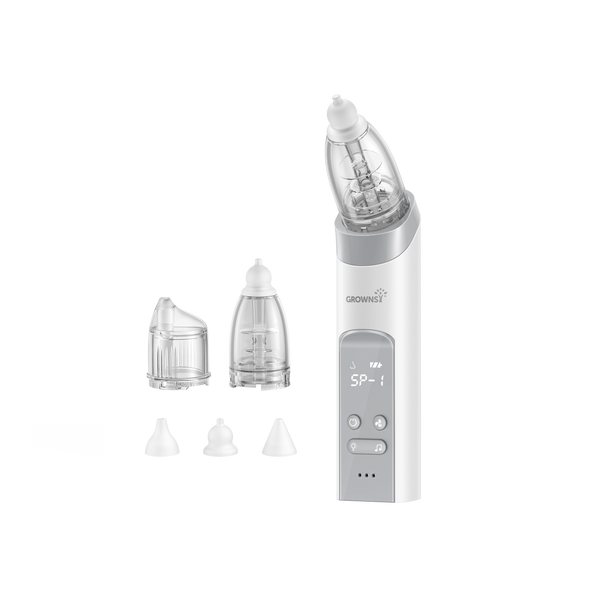
Grownsy Nasal Aspirator
Grownsy Nasal Aspirator: Your little vocalist needs a clear airway to practice their sweet new coos and babbles, and this gentle aspirator quickly clears away any congestion, while the built-in lullabies and lights turn a stressful routine into a fun, vocal distraction.
Grownsy Baby Car Camera & HD Monitor
Grownsy Baby Car Camera & HD Monitor: Early language milestones are predicated on interaction, so this crystal-clear 1080P dashboard monitor can help you observe your baby’s face, smiles, and babbles during longer car rides. You get total peace of mind without taking your eyes off the road.