


If you're a new parent, you may have wondered:
"When can my baby start using a swing?"
The answer isn't simply a number of weeks or months.
Some infant swings are designed for use from birth, while others have different requirements. The right time depends on the specific swing, your baby's size and developmental stage, and the manufacturer's instructions.
Here's what parents should know before putting a baby in a swing.
Can Newborns Use a Baby Swing?
Some baby swings are designed for newborns and can be used from birth.
But "from birth" does not mean every newborn can use every swing.
Before using one, check the product's:
- Minimum weight requirement
- Maximum weight limit
- Age range
- Recline requirements
- Head and neck support
- Harness or restraint instructions
- Developmental-use warnings
Newborns have limited head and neck control, so positioning is especially important.
For swings with adjustable recline, follow the manufacturer's instructions for the appropriate position for young infants. CPSC guidance includes warnings for certain swings that require the seat to remain fully reclined until the infant is at least 4 months old and can hold their head up without help.
When Can Babies Start Using a Swing?
If your swing is specifically designed for newborns, your baby may be able to use it from birth.
If the manufacturer specifies a later starting age, wait until your baby meets that requirement.
The safest answer is always the one in the manual for your specific product.
That's because "baby swing" can describe several different types of products. CPSC distinguishes between infant swings, cradle swings, combination swings, and travel swings, and their intended developmental ranges can differ.
So instead of asking only:
"How old does my baby need to be?"
also ask:
"Does my baby meet this swing's developmental and weight requirements?"
What Developmental Signs Matter?
Age is only one part of the picture.
Depending on the swing, developmental milestones can affect when it is appropriate to use---or stop using---the product.
Pay attention to signs such as:
Head Control
Young babies have limited ability to control their heads and necks.
If the swing's instructions specify a reclined position for younger infants, follow that requirement carefully.
Rolling and Pushing Up
For products designed for infants lying in a cradle-like position, developmental milestones such as rolling or pushing up on hands and knees can signal that it's time to stop using that configuration.
CPSC's definition for cradle swings describes them as intended for infants from birth until they begin to push up on their hands and knees, approximately around 5 months.
Your specific product may have different requirements, so always check its instructions.
Trying to Climb Out
Once your baby starts trying to climb out of an infant swing, it's time to stop using it.
CPSC's infant swing guidance describes infant swings as intended for use until a child attempts to climb out, approximately around 9 months. Again, this is a general standard definition, not a universal age limit for every product.
A baby's development doesn't always follow a calendar.
How Long Can a Baby Stay in a Swing?
There isn't one universal number of minutes that applies to every baby and every swing.
The important distinction is between supervised awake time and sleep.
A swing may be used during supervised awake time according to the manufacturer's instructions. But it shouldn't be treated as a place for routine naps or overnight sleep.
The American Academy of Pediatrics recommends that babies sleep on a firm, flat, non-inclined surface intended for infant sleep. Swings and other sitting devices are not recommended for routine sleep.
If your baby falls asleep in a swing, move them to an appropriate sleep surface as soon as practical.
Why Can't Babies Sleep in a Swing?
You may have seen a baby peacefully sleeping in a swing and wondered why it's considered different from a crib.
The issue is the position.
A swing is designed to hold a baby in a seated or reclined position, rather than provide the firm, flat sleep surface recommended for infants.
According to the AAP, sitting devices such as swings are not recommended for routine infant sleep, particularly for babies younger than 4 months. CPSC also states that inclined products such as swings should not be used for infant sleep.
That's why a swing and a bassinet have different jobs:
Swing: supervised awake time and soothing movement.
Bassinet/crib: infant sleep.
Keeping those roles separate is an important part of creating a safe routine.
When Should You Stop Using a Baby Swing?
Don't wait until your baby reaches a specific birthday if they have already reached the product's developmental limit.
Stop using the swing when:
- Your baby exceeds the manufacturer's weight limit.
- Your baby exceeds the height limit, if one is specified.
- Your baby attempts to climb out.
- Your baby can no longer be positioned safely according to the instructions.
- The product shows signs of damage or instability.
- The manufacturer specifies that use should stop after a particular developmental milestone.
For some infant swings, attempting to climb out is the key stopping point. CPSC's guidance uses approximately 9 months as a general reference for this developmental limit, but individual products may specify different requirements.
How to Use a Baby Swing More Safely
Once you've confirmed that your baby is within the product's intended range, a few basic habits can make everyday use safer.
Always Use the Restraint System
Secure your baby according to the manufacturer's instructions every time.
Don't skip the harness just because you're sitting nearby.
Use the Recommended Position
If your swing has multiple recline settings, use the setting appropriate for your baby's age and developmental stage.
Don't improvise with additional pillows, cushions, blankets, or other positioning products.
Keep the Swing on the Recommended Surface
Follow the manufacturer's instructions about where the swing can be placed.
Travel swings and other low-profile products may have specific placement requirements.
Stay Within Reach and Supervise
A swing is not a substitute for active supervision.
Keep an eye on your baby while they're using it, particularly when they're very young or still developing head and neck control.
Check the Product Regularly
Before use, look for anything that seems loose, damaged, cracked, or otherwise different from the product's normal condition.
If something doesn't look right, stop using the product until you've determined whether it is safe to continue.
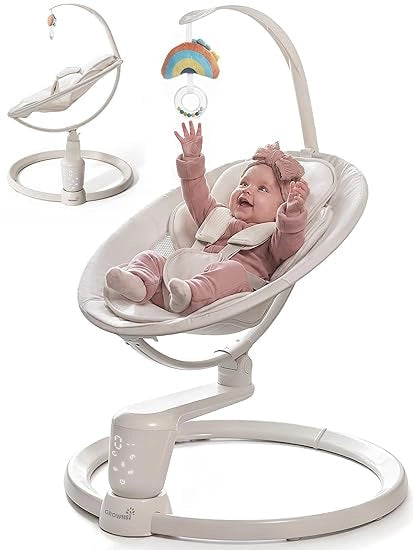
A Simple Age-and-Stage Guide
Because every baby develops differently, think of this as a general framework, not a replacement for your product manual.
| Stage | What to Check |
|---|---|
| Newborn | Is the swing specifically approved for use from birth? Is the recline appropriate? |
| Early infancy | Does your baby have the head and neck support required by the product? |
| Around 4+ months | Check the manufacturer's recline and developmental requirements as head control improves. |
| Rolling / pushing up | Check whether your swing or cradle configuration should be discontinued. |
| Trying to climb out | Stop using the infant swing. |
| Any stage | Follow the product's weight, height, age, and developmental limits. |
The Bottom Line
So, when can babies use a swing?
If the swing is designed for newborns, it may be appropriate from birth---but only when your baby meets the product's requirements and the swing is used exactly as directed.
As your baby grows, developmental milestones matter just as much as age. Head control, rolling, pushing up, and attempts to climb out can all affect whether a swing is still appropriate.
And one rule is especially important:
A baby swing is for supervised use---not sleep.
For sleep, move your baby to a firm, flat, non-inclined sleep surface designed for infants.
The goal isn't to find a magic age when every baby can use every swing. It's to match the right product, position, and stage---so your baby can enjoy the movement while you get a little more room to breathe.


