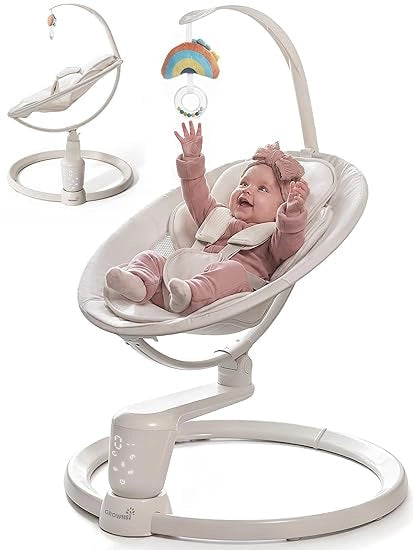
Becoming a parent comes with a long list of firsts and choosing your baby's first swing can be one of them.
With so many baby swings offering different motions, recline positions, speeds, sounds, timers, and features, it can be difficult to know what actually matters. If you're a first-time parent, you don't necessarily need the swing with the longest feature list. You need one that fits your baby's stage, your daily routine, and the way your family actually lives.
So, what should you look for when choosing a baby swing?
What Is a Baby Swing Used For?
A baby swing is designed to provide a comfortable, supported place for an infant to sit while the seat moves with a gentle swinging or gliding motion.
For many families, a swing can be useful during awake time when parents need a few hands-free minutes whether that's preparing a meal, folding laundry, answering an email, or simply taking a breath.
A swing isn't a replacement for holding your baby, floor play, or supervised interaction. Think of it as another tool in your parenting toolkit.
7 Things First-Time You Should Look For in a Baby Swing
-
An Age-Appropriate Design
The first question isn't "How many features does it have?"
It's "Is it designed for my baby's current stage?"
Infant swings can have different designs and intended age or developmental ranges. Some are designed for use from birth, while others have more specific requirements based on the baby's head control, developmental abilities, or the swing's configuration.
Always check the manufacturer's age, weight, height, and developmental requirements before using a swing.
As your baby grows, their abilities change quickly. A swing that works well during the newborn stage may not be appropriate once your baby begins trying to sit up, climb out, or otherwise exceed the product's intended use.
-
A Supportive, Adjustable Seat
Young babies don't have the same head and neck control as older infants, so supportive seat matters.
Look for a swing with a well-supported seat and appropriate recline options. An adjustable recline can also make it easier to find a comfortable position as your baby develops.
For younger infants, follow the manufacturer's instructions carefully regarding the most reclined position.
The U.S. Consumer Product Safety Commission (CPSC) has specific safety requirements for infant swings, including requirements related to restraints, stability, and positioning. Some swing warning labels specify keeping the seat fully reclined until a baby is at least 4 months old and can hold their head up without help. Always follow the instructions and warnings for your specific model.
-
A Secure Restraint System
A good swing should make it easy to secure your baby correctly.
Look for a restraint system that:
- It is easy for parents to use correctly
- Fits snugly without being uncomfortable
- Stays securely fastened during movement
- Doesn't require complicated adjustments every time
Never assume that a calm baby doesn't need to be buckled in. The restraint system should be used every time according to the manufacturer's instructions.
-
Motion Options That Fit Your Baby
Different babies have different preferences.
Some may enjoy a gentle side-to-side motion. Others may prefer a front-to-back swing or a slower, more rhythmic movement.
If you're comparing swings, consider whether the motion can be adjusted rather than assuming that more speed is better.
A wider range of motion settings can give you more flexibility, but the goal isn't to keep increasing speed. Start with the setting recommended by the manufacturer and observe how your baby responds.
-
Simple Controls
This is one feature first-time parents often appreciate more after bringing the baby home.
When you're holding a baby in one arm and trying to operate a product with the other, complicated controls can quickly become frustrating.
Look for controls that are:
- Easy to understand
- Easy to reach
- Clearly labeled
- Simple to adjust during everyday use
Features such as multiple motion speeds, timers, music, or sounds can be useful but only if they're easy to operate.
The best feature is often the one you can actually use when you're running on very little sleep.
-
Easy Cleaning
Babies are messy. That's not a design flaw, it's just life with a baby.
Spit-up, milk dribbles, drool, and the occasional diaper-related surprise can all find their way into baby gear.
For that reason, check how easy the swing is to clean before buying it.
Look for removable or washable fabric where available, wipeable surfaces, and a design that doesn't create unnecessary hard-to-reach spaces.
A beautiful swing that takes forever to clean may become much less appealing after a few weeks of real-life use.
-
A Size That Works for Your Space
Baby gear adds up quickly.
Before choosing a swing, think about where you'll actually use it. Is it going in the living room? Nursery? Kitchen? Will you need to move it between rooms?
Consider:
- Overall footprint
- Weight
- Portability
- Folding or storage options, if available
- Distance from walls and other furniture
- Whether the swing can be placed on a stable, level surface as directed
A compact swing can be particularly useful for families with limited space, while a larger design may offer additional features or a different seating experience.
What About Extra Features?
Once the essentials are covered, you can start thinking about the extras.
Depending on the model, baby swings may offer features such as:
Multiple motion settings: Useful when your baby responds differently to different rhythms.
Music and sounds: Can add another layer of soothing stimulation, although some babies may simply prefer quiet.
Timer settings: Helpful when you want the swing to run for a set period rather than continuously.
Remote or app controls: Convenient for some families, especially when the controls are designed to be simple and reliable.
Adjustable recline: Can provide more flexibility as your baby develops, as long as each position is used according to the manufacturer's instructions.
More features don't automatically make a swing better. Think about which ones solve an actual problem in your daily routine.
Can a Baby Sleep in a Swing?
This is one of the most important things for first-time parents to know.
A baby swing is not a safe sleeping space.
The American Academy of Pediatrics recommends that babies sleep on a firm, flat, non-inclined surface designed for infant sleep. Sitting devices, including swings, are not recommended for routine sleep. If your baby falls asleep in a swing, move them to an appropriate sleep surface as soon as practical.
In other words: a swing can be part of supervised awake time, but it shouldn't become your baby's crib or nap space.
So, What Is the Best Baby Swing for First-Time Parents?
There isn't one swing that is best for every family.
Instead, look for a swing that matches your baby's developmental stage and your family's everyday needs.
For first-time parents, a practical checklist might look like this:
- ✓ Appropriate for your baby's age, weight, and developmental stage
- ✓ Supportive seating and appropriate recline
- ✓ Secure restraint system
- ✓ Stable construction
- ✓ Easy-to-use controls
- ✓ Adjustable motion
- ✓ Easy-to-clean materials
- ✓ A size that works in your home
- ✓ Clear instructions and safety warnings
- ✓ Features that genuinely fit your routine
The right baby swing shouldn't add another complicated task to your day. It should simply give you another way to create a little space for feeding, tidying up, making dinner, or enjoying a few quiet minutes together.
Because sometimes, a little hands-free time is exactly what new parents need.