Baby-Led Weaning Foods: Safe First Foods, How to Cut Them, and What to Offer by Age
Introducing solid foods to your child is one of the most exciting milestones of your baby’s first year. While the traditional approach involves weeks of smooth purées and parent-led spoon-feeding, an increasingly popular alternative skips the mush entirely.
Welcome to the world of baby-led weaning foods. An exciting “hands-on” experience that allows your little one to explore new flavors and textures and build a healthy, confident relationship with real food right from their very first bite. First-time parents may think that baby-led weaning is about stopping breast milk or formula milk, but it is not.
What is Baby-Led Weaning & Is It Right for Your Baby (and You)?
Baby-led weaning (BLW) is when your baby feeds himself age-appropriate solid foods. Instead of focusing on purees first, babies are introduced to solids that they can safely hold in their hands. They are given opportunities to pick up food, bring it to their mouths, and explore different tastes and food textures at their own pace.
Deciding if BLW is the right path often comes down to two factors: your baby’s temperament and your own comfort level. If your little one is fiercely independent, constantly reaching for your plate, and shows interest in sharing your bowl, they are likely a natural candidate for self-feeding.
However, as a parent, you must also consider that baby-led weaning is naturally messy, and witnessing those early, natural gagging reflexes can be nerve-wracking for first-time parents. If the thought of handing over a steamed sweet potato wedge causes too much stress, it is perfectly okay to start with purées or use a flexible mixed approach.
Baby-Led Weaning vs. Traditional Spoon-Feeding
Traditional weaning relies on parent-led spoon-feeding with uniform purées. Baby-led weaning (BLW), on the other hand, skips the purée step. You place safe, bite-sized pieces of baby-led weaning first foods directly into your baby's hands. It allows babies to interact directly with the food, control the pacing, volume, and mechanics of their meal.
Why BLW Focuses on Self-Feeding, Texture, and Family Meals
BLW is rooted in exploration and motor autonomy. By managing soft, textured pieces, your baby builds chewing and essential oral motor skills (moving food to the sides of the mouth). Best of all, eating modified versions of the exact same dinner the rest of the family enjoys fosters social learning through direct mimicry.
Instead of preparing a separate meal for babies, parents give them the same healthy food, in a modified form suited to their age that everyone else is eating. If you are enjoying baked sweet potato for dinner, the baby can have it as small wedges.
When a Mixed Approach Can Be Helpful
When starting baby-led weaning, some parents might feel their baby is not being properly fed and want to combine it with spoon-feeding. And it’s totally okay. Or, sometimes if a grandparent or a caregiver has to babysit your baby, they might feel more comfortable with spoon-feeding.
A mixed approach can be especially helpful if your baby enjoys both finger foods and spoon-fed foods. Also, when you're introducing naturally smooth foods like yogurt or oatmeal, spoon-feeding is preferred.
Is My Baby Ready? Age and Developmental Readiness Signs
The Best Age to Start Baby-Led Weaning
According to the American Academy of Pediatrics, breast or formula milk should not be the sole diet once your baby gets 6 months old. Complementary solids should be part of their daily diet as their eating skills continue to develop. Also, at this age milestone, a baby’s digestive tract has matured enough to produce the necessary enzymes to process solid food structures. This is to ensure that your baby is getting the appropriate infant nutrition while still receiving formula/breast milk during the weaning process.
Baby-Led Weaning Readiness Signs
Age is just a single data point; physical milestones dictate true safety. Your baby must show these specific markers before handling baby-led weaning foods at 6 months and up. Some readiness signs include:
- Unassisted Sitting: Sitting upright with little or no support, to help them stay in a safe position while they are self-feeding.
- Excellent Head Control: Holding their head/neck steady so they can swallow without risks.
- Hand & mouth coordination: Because if your baby is able to pick up a toy, especially, for example, a silicone teething toy, and bring it to their mouth, he can do the same with his food too.
- The Absence of Tongue-Thrust: They should no longer automatically push solid objects out of their mouth with their tongue.
If you think your baby in their high chair is curious about how you eat your food or maybe even tries to take your spoon in their hands, it is the cue that they are getting ready for baby-led weaning.

When to Wait or Ask Your Pediatrician
While most babies are ready for weaning by 6 months of age, you might consider asking your pediatrician if your baby was born premature, has any kind of medical condition, or shows poor head-neck control.
Gagging vs. Choking
According to the AAP, gagging is common when babies begin baby-led weaning first foods and is part of learning how to manage different food textures. Gagging is a normal reflex and can involve coughing, noisy retching, or pushing food out of the mouth. This improves with practice. However, it can be startling for parents who often confuse and fear it for choking.
Choking is completely different! When babies choke, they are unable to cry, cough, or even breathe because their airways get blocked.

First Foods to Offer: BLW Food Lists by Age, Texture, and Iron
Best First Foods for 6–8 Months
At this stage, your baby uses their whole hand. They use the palmar grasp to hold objects. Your baby-led weaning starter foods must be cut into long, thick strips the size of an adult index finger. The food should be soft enough to easily smash between your thumb and forefinger. Some of the best baby-led weaning first foods include:
- Scrambled egg bits
- Flaked Salmon
- Shredded beef
- Tender chicken strips
- Avocado slices
- Steamed broccoli
- Banana & Carrot strips
- Tofu
- Pear/Peach slices
- Oatmeal/Yogurt

Best BLW Foods for 9–12 Months
By 9- 12 months, most babies have become confident eaters with a stronger grasp and hence are ready for many more textures. In this phase, the first foods for baby led weaning should transition from long finger strips to small, bite-sized cubes about the size of a chickpea.
- Soft pasta
- Soft rice
- Tender meatballs
- Soft lentils
- Pasteurized grated cheese
- Whole-grain toast
- Ripe fruits & soft-cooked veggies
How to Introduce Allergens during Baby-Led Weaning
First solids are sometimes accompanied by parents worrying about allergens, and it’s completely natural. But modern pediatric guidelines show that delaying the introduction of highly allergenic foods can actually increase the risk of developing childhood food allergies. The goal is early, intentional exposure once your baby has successfully tolerated a few basic, low-allergen starter vegetables.
Common Allergens to Introduce: Peanut, Egg, Dairy, Fish, Wheat, and Soy
Common allergens include peanuts, egg, dairy, fish, gluten (wheat, rye), nuts, soy, sesame, and shellfish. NIH research shows that introducing them early (after 6 months) reduces the risk of developing allergies later in life.
Of course, introduce only one allergen at a time by preparing it in a texture that is suitable for your baby. Notice whether your child tolerates it well, then move on to the next ones after 3-5 days. If your baby eats these without any reaction, you should give them more frequently to help maintain this tolerance.
Safe Ways to Serve Allergenic Foods
- Avoid whole peanuts, and mix peanut butter with yogurt or breastmilk or in oatmeal.
- Give only properly cooked fish with its bones removed.
- Prepare fully cooked eggs
- Wheat can be offered in the form of pasta, soft pancakes, or cereals.

As for dairy, before 12 months, cow’s milk is not recommended, so you can introduce dairy using yogurt or cheese.
Frequency of Offering Allergens After Introduction
Once an allergenic food is introduced without any negative reaction, it is critical to keep it in your baby's diet regularly. According to the American Academy of Allergy, Asthma & Immunology (AAAAI), maintaining a frequency of 2 to 3 times per week for each tolerated allergen helps maintain long-term immune tolerance.
Signs of an Allergic Reaction to Watch For
Most babies tolerate new foods well, but it is important to know what an allergic reaction looks like so you can identify it quickly and avoid the food allergens for your baby in the future.
These signs include:
- Itching or Rash
- Swelling on any part or whole face
- Post-Vomiting
- Continuous coughing/wheezing
- Shortness of breath
- Paleness or tiredness
- Sudden behavior or gait changes
When to Talk to a Pediatrician or Allergist First
These signs must be dealt with with immediate medical help. If your baby suffers from severe eczema or has a known, diagnosed food allergy (such as an existing egg allergy), consult your pediatrician or a pediatric allergist before introducing peanuts or other high-risk allergens at home.
Choking Prevention, Safety, and How to Handle Emergencies
Choking is a medical emergency and requires urgent medical help. First aid includes alternating five back blows until the object dislodges, or at least until help arrives. Do not perform blind finger sweeps.
Safe Food Shapes and Sizes by Age
Choking can be prevented by preparing and offering foods with age-appropriate textures and shapes. Some foods that are more prone to cause choking are often given whole, like whole grapes, cherry tomatoes, whole nuts, candies, popcorn, chewing gum, marshmallows, raw apples or carrots, and hard vegetables.
Foods to Avoid or Modify for Babies
Certain structural shapes must be strictly avoided or physically altered before they ever touch your baby's tray. Modifying foods by cutting, cooking, or making them soft reduces the risk to a greater extent.
- Whole Round Foods: Grapes, blueberries, and cherry tomatoes must be cut lengthwise into quarters.
- Hard, Crunchy Textures: Raw carrots, raw apples, and nuts are completely banned. Apples and carrots must be steamed until soft.
- Coin Shapes: Hot dogs or sausage links must be split lengthwise and diced into tiny bits.
How to Set Up a Safe High Chair Feeding Environment
To prevent choking, use a high-chair-safe feeding environment for baby mealtimes and make them sit upright to help them swallow properly. Your high chair must position your baby at a strict 90-degree angle—upright, hips tucked back, with an adjustable footrest supporting their feet. Never let a baby eat while reclining, crawling, or riding in a moving stroller or car seat, where sudden movements can cause unexpected aspiration.
What to Do If Your Baby Chokes
If your baby is choking, you must act instantly. Alternating between 5 firm back blows (using the heel of your hand between their shoulder blades while holding the baby face-down on your forearm) and 5 sharp chest thrusts (using two fingers on the center of the breastbone) is the medical standard to dislodge an obstruction.
Parents Should Consider Infant CPR and First Aid Training
First aid and infant CPR can be learnt by parents through organizations such as the American Red Cross or the American Heart Association. We hope you never have to use these, but learning these skills gives parents greater confidence and satisfaction before starting any weaning method.
Meal Schedules, Portions, and Practical Meal Plans for BLW
How BLW Fits with Breast Milk or Formula
Baby-led weaning must not replace breast milk or formula, especially during the first year of life. Milk provides the primary nutrition along with weaning/complementary foods. To fit weaning with milk, most parents prefer to serve milk first, especially at the start, to ensure the baby doesn’t stay hungry while he is still learning to eat solids to his fill. This is especially true for 6-8 months, when babies eat less and leave more on their plates and on the floor.
Here is what a sample meal plan for a 6-8-month-old baby might look like:
| Morning | Breast Milk/Formula |
|---|---|
| Breakfast | Scrambled egg small chunks/soft banana |
| Midday | Breast Milk/Formula |
| Lunch | Breast Milk/Formula |
| Dinner | Roasted Sweet Potato Wedges/Steamed Broccoli |
| Night | Breast Milk/Formula |
Simple Plate Formula: Iron Source, Soft Produce, Healthy Fat, and Grain
Around 6 months of age, the baby’s natural store of iron starts declining. So, the initial choice of baby-led weaning foods must include food from a variety of food groups rather than just fruits or vegetables.
Some excellent iron-rich foods include soft-cooked red meats, eggs, and dark poultry. But for vegan/vegetarian families, lentils, tofu, beans, chickpeas, soy yogurt, and iron-fortified cereals are great options. Pairing these foods with vitamin C-rich combinations like sweet potato, broccoli, or strawberries will naturally help in greater iron absorption.
The ideal way for baby-led weaning is to create a balanced BLW plate for your baby. It may include an iron source (meat or plant), a piece of fruit or veggie, a healthy fat (olive oil/nut butter), and a whole-grain/starchy food (soft rice/pasta).
How Much Food to Offer at Each Meal
Start by placing just 2 or 3 pieces of food directly on the high chair tray at a time. Piling a tray high with options can easily overwhelm a baby's developing sensory system, leading them to reject the meal entirely.
Keep portion sizes small initially. Do not force-feed; trust their hunger and fullness cues. You can always increase the portions of the foods your baby enjoys.
How to Adjust During Illness, Teething, or Growth Spurts
When your baby is teething or under the weather, they will naturally seek comfort and revert to fluid-heavy nutrition. Do not panic if they refuse solid foods for a few days; offer soft, cooling finger foods like cold cucumber strips or chilled melon wedges to soothe tender gums.
For illnesses, if a baby refuses solids, just continue with breast milk/formula and choose the comfort solids they most like.

Easy BLW Recipes, Prep Tips, and Freezer-Friendly Foods
You don’t have to spend hours making or preparing baby-led weaning foods. Here are some of the best first foods for baby led weaning.
Simple BLW Breakfast Ideas
These can include:
- Banana and oat pancakes
- Scrambled fully-cooked eggs
- Oatmeal with mashed berries
- Toast fingers with mashed avocado
- Soft peach slices with cottage cheese
Easy Lunch and Dinner Finger Foods
These can include:
- Shredded chicken small strips with potato wedges
- Flaked, soft salmon with soft, boiled rice
- Lentil patties with cucumber sticks
- Soft pasta with veggies and olive oil sprinkle
Freezer-Friendly BLW Recipes for Busy Parents
Many baby-led weaning foods can be frozen while preserving their textures and flavors.
These can include:
- Pancakes
- Meat/Lentils Patties
- Homemade Meatballs
- Roasted Veggies
- Vegetable muffins.
The best advice here is to freeze small portions, so later on you will thaw only what you will actually use. Label each packet and use it within 2-3 months to ensure the best quality.
Best Recipes to Get Started With Baby-Led Weaning
Here are some recipes that are easy to prepare in batches. They can be frozen and then reheated later on when required.
Banana Oat Pancakes (8 pancakes)
Prep Time: 5 minutes
Cook Time: 6 minutes
Ingredients: 1 ripe banana, 1 egg, ¼ cup of oats, ½ tsp honey, ¼ tsp cinnamon
Instructions:
- Peel one large banana and mash it using a fork.
- Whisk a large egg in a bowl and then add the mashed banana.
- Then mix this batter with oats, cinnamon, and honey.
- Stir everything properly and let the batter rest for 3-5 minutes.
- Light the stove on medium-low heat and add some olive oil.
- Once it gets warm, pour the batter into the pan to make even-sized small pancakes.
- Let the pancakes cook for about 3 minutes on each side or until golden.
- Take them out onto the plate and let them cool a bit before serving.

Serving Size: 1-2 pancake strips. Can be served with favorite fruit.
Allergen Information: Contains eggs
Texture Adjustments:
- 6-8 months: Cut the pancakes into finger strips
- 9-12 months: Bite-sized pieces of pancakes
Storage & Freezing: Can be kept in the refrigerator for up to 3 days and in the freezer for about 3 months. Make sure to refrigerate or freeze in an airtight container.
Reheating: Let it thaw, and then warm properly in a pan or in the oven.
Nutrition per serving: Cals: 33, Carbs: 5.5 g, Proteins: 1.3g
Turkey & Sweet Potato Patties (about 12 patties)
Prep Time: 15 minutes
Cook Time: 20 minutes
Ingredients: 200 g lean ground meat, 1 cup of mashed roasted sweet potato, 1 egg, 2 tbsp of oat flour, ½ tsp of garlic powder, pinch of black pepper

Instructions:
- Preheat the oven to 190°C.
- Take a medium-sized bowl and whisk an egg into it.
- Add ground meat, mashed potato, and flour to the bowl.
- Mix everything properly so that they are well combined.
- Then make equal-sized small patties of this mixture.
- Spread baking paper on a baking tray.
- Arrange all the patties on the tray and bake them in the preheated oven for about 20 minutes.
- When they are baked, take them out onto the serving plate.
- Let them cool and then enjoy.
Serving Size: 1 patty usually served with soft steamed veggie fingers.
Allergen Information: Contains eggs
Texture Adjustments:
- 6-8 months: Whole patty or cut into fingers
- 9-12 months: Bite sized pieces of patty
Storage & Freezing: Can be kept in the refrigerator for up to 3 days and in the freezer for about 3 months. Make sure to refrigerate or freeze in an airtight container.
Reheating: Let it thaw, and then warm properly in a pan or in the oven.
Nutrition per serving: Cals: 50, Carbs: 4.3 g, Proteins: 4.5 g
Lentil & Veggie Bites (about 12 bites)

Prep Time: 15 minutes
Cook Time: 25 minutes
Ingredients: 1 cup cooked lentils, ½ cup of properly chopped carrots, ¼ cup of chopped spinach, 1 egg, 1 tbsp olive oil, ½ tsp cumin, ¼ tsp oregano
Instructions:
- Preheat the oven to 190°C.
- Use a fork to mash the cooked lentils properly.
- Transfer the mashed lentils to a bowl.
- Mix them with chopped carrots, spinach, oil, and seasonings.
- In a small bowl, whisk an egg.
- Add this whisked egg to the lentil mixture, and mix everything very well.
- Shape the mixture into bites or patties.
- Put the parchment paper on a baking tray and arrange these lentil patties onto it.
- Bake for about 25 minutes, turning halfway through.
- Take them out on a plate, let them cool, and then serve.
Serving Size: 1 patty usually served with soft steamed veggie fingers.
Allergen Information: Contains eggs
Texture Adjustments:
- 6-8 months: Whole patty/ cut into finger-shaped strips
- 9-12 months: Bite-sized pieces of patty
Storage & Freezing: Can be stored in the refrigerator for up to 3 days and can be kept in the freezer for about 3 months. Make sure to refrigerate or freeze in an airtight container.
Reheating: Let it thaw, and then warm properly in a pan or in the oven.
Nutrition per serving: Cals: 38, Carbs: 3.5 g, Proteins: 2g
How to Batch Cook and Reheat Baby-Led Weaning Foods
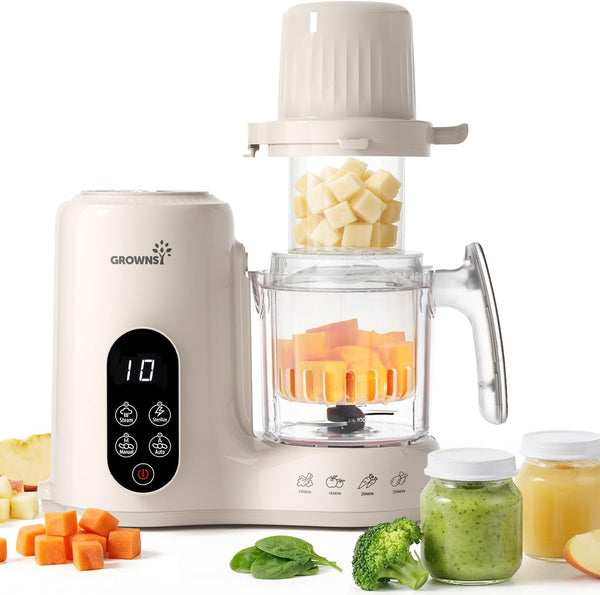
When it comes to batch cooking baby-led weaning food, maintaining a pristine texture can be a real challenge for parents. The reason? The texture of baby-led weaning starter foods could be a deal breaker for those little picky eaters. This is exactly where the Grownsy Baby Food Maker comes into play as parents' best friend in the kitchen. The gadget’s 3-mode support lets you choose your child’s preferred texture (smooth, lumpy, chunky), of course depending on the age.
Even better, its elevated steamer uses precise steam circulation to cook vegetables rather than boiling veggies in a pot of water—which leaches out valuable micronutrients.
Here’s how it works:
- Prep & Chop: Wash, peel, and chop fresh vegetables or lean proteins into uniform pieces for an even cook.
- Steam: Fill the water reservoir, place food in the basket, and select steam mode. The auto-shutoff feature ensures your food never burns.
- Customize Texture: If you are following a flexible combination feeding, use the dual-mixing mode to easily pulse ingredients into chunky mashes or smooth, high-iron spreads.
Built from premium, Tritan BPA-free material with a built-in sterilizer mode, it gives you total peace of mind that every single batch is clean and safe. When you're finished, the removable, dishwasher-safe components completely eliminate any worries about mold or difficult cleanups.
Vegetarian and Vegan BLW Recipe Swaps
All the baby-led weaning recipes can be adapted to suit a vegetarian or vegan diet. Here are some options:
- Meat Patties -> Lentil Patties
- Meatballs -> Quinoa Balls/Bean Balls
- Fish/Salmon -> Baked tofu strips
- Yogurt -> Fortified plant-based yogurts
Conclusion
Baby-led weaning is a rewarding transition that welcomes your newest family member directly into your household's mealtime rhythms. It requires patience and a lot of encouragement. The messy first weeks and refused foods are part of this adventure. In no time, you will see your baby develop into a confident, healthy eater. Also, whatever feeding mode you choose for your baby, trust your instincts and go for it. Remember, the best feeding approach is the one that works both for you and your little one.