


9-Month-Old Sleep Schedule: The Complete Guide for Tired Parents
If you’re reading this at 2 a.m. on a Tuesday and your 9-month-old is awake and attempting to stand up in the crib, you’ve come to the right place. This is a hard age to sleep through. Development is booming, separation anxiety kicks in and all of a sudden schedules go out the window after two months.
This guide will teach you everything you need to know to create a successful 9 month old sleep schedule.

How Much Sleep Does a 9-Month-Old Need?
Total Sleep in 24 Hours: What's Normal at This Age
The AAP and American Academy of Sleep Medicine recommend 12 to 16 hours of sleep in a 24-hour period, including naps, for infants 4 to 12 months old. Specifically at nine months when things are going well most babies will fall somewhere between 13-14 hours.
That said, all babies are different. Some do fine with 12.5 hours, some need more like 15. Watch your baby’s cues rather than aiming for a perfect number.
How Much Nighttime Sleep Should Your Baby Get?
The average 9-month-old gets about 10 to 11 hours of sleep at night. Babies will start to sleep about 10 hours a night at some point during their first year, according to The Mayo Clinic. Some babies stretch to 11.5 hours, especially with an early bedtime, but many still wake once overnight.
How Much Daytime Sleep Does Your Little One Still Need?
At nine months, most babies still need 2.5 to 3.5 hours of daytime sleep spread across two naps. Naps are usually 1-1.5 hours long. It’s okay if your baby is still taking three shorter naps, but most babies are ready to combine by now.
Wake Windows for a 9-Month-Old
Wake windows are the gaps of time your baby is awake in between sleep periods. At nine months these are usually 2.5 to 3.5 hours. Getting this right matters more than almost anything else in the schedule.
Why Morning and Evening Wake Windows Feel So Different
The first wake window of the day, from wake-up to first nap, is usually the shortest, about 2.5 to 3 hours. Babies genuinely have less stamina first thing in the morning.
The last wake window of the day before bed is usually the longest, often 3 to 3.5 hours long, but it is also the most delicate. Push it too far and you'll have an overtired, wired baby who takes forever to settle.
Is My Baby Overtired or Just Not Tired Enough?
Both "overtired" and "undertired" seem counterintuitive, but they show up at bedtime with the same symptoms: fussiness, fighting sleep and waking up frequently. An overtired baby will usually show you the signs in the day, such as rubbing eyes, zoning out, and meltdowns.
A baby who is not tired enough is usually happy at bedtime but simply will not close their eyes. Track wake windows for a day or two and the pattern will often become obvious.
Sample 9-Month-Old Sleep Schedule
Sample 2-Nap Schedule Most Babies at 9 Months
| Time | Activity |
|---|---|
| 7:00 AM | Wake up, feed |
| 9:30–10:00 AM | Nap 1, 60–90 min |
| 11:00 AM | Wake, feed, play |
| 1:30–2:00 PM | Nap 2, 60–90 min |
| 3:00–3:30 PM | Wake, feed, play |
| 6:30–7:00 PM | Begin bedtime routine |
| 7:00–7:30 PM | Bedtime |
Sample Schedule for Babies Still on 3 Naps
A few nine-month-olds still need a third short catnap, 30 to 45 minutes, in the late afternoon, especially if nap one and two are both shorter. If your baby is doing well with two naps and 10 to 11 hours at night, there’s no need to add one.
| Time | Activity |
|---|---|
| 7:00 AM | Wake up, feed |
| 9:30 AM | Nap 1, 45–60 min |
| 11:30 AM | Nap 2, 45–60 min |
| 2:00 PM | Nap 3, 30–45 min catnap |
| 7:00–7:30 PM | Bedtime |
What Time Should Your Baby Go to Bed?
Most nine-month-olds do well with a bedtime between 7:00 and 8:00 PM. Rising before 6:30 PM can result in waking up early in the morning. Late nights, after 8:30 PM, often result in overtiredness, which breaks up night sleep.
Why Is Your Baby's Sleep So Disrupted at 9 Months?
Crawling, Standing, and Practicing Motor Skills in the Crib
Between 8-10 months, gross motor skills progress quickly. Pulling to stand is an important milestone at this stage as it shows a baby has developed the core strength to come up, says Stanford Medicine Children's Health. Babies should be pulling to stand by 12 months.
The problem is their brains compulsively practice new skills in sleep transitions too. Put them in a crib and they often pop right up to standing. Sometimes even before they are fully awake.
Separation Anxiety and Object Permanence
Babies become better at understanding object permanence by around 8 to 9 months. They know you are there even if they can't see you.
This is a developmental milestone but it fuels bedtime separation anxiety and night waking. Your baby is not trying to manipulate you. They just need to know that you are still there.
The Nap Transition: Dropping the Third Nap
That’s usually about nine months, the time when your baby will drop the third nap if they haven't already.
Signs they’re ready: consistently fighting the third nap, difficulty falling asleep at bedtime, or waking up earlier in the morning than usual. Drop it 30 minutes earlier first and move bedtime 30 minutes earlier to make up for lost sleep in the daytime.

9-Month Sleep Regression
The 8- to 10-month sleep regression is one of the most disruptive parts of maintaining a consistent 9 month old sleep schedule.
It’s the same developmental surge mentioned above, the motor skills, the cognitive leaps, the separation anxiety, the nap transition all crashing together. Most families notice it in the last two to six weeks. It is extremely difficult but it does end.
Regression or a Schedule Problem?
This is worth an honest inquiry. A true regression is one that happens suddenly in a baby that used to sleep well. There’s usually been some kind of schedule issue happening: naps too short, wake windows too long, bedtime creeping later and later.
If the sleep has been rocky for months rather than weeks, it’s more likely a schedule problem that should be tackled head on.
Build a Bedtime Routine for Your Little One
A Simple Step-by-Step Bedtime Routine, 20–30 Minutes
One of the best ways to improve infant sleep is to have consistent, calming pre-sleep routines, according to the Mayo Clinic. Keep it simple and do it in the same order each night.
- Warm bath, optional but helpful
- Gentle massage or cream
- New diapers and new pajamas
- Feed, breast or bottle
- One short book or song
- Into the crib, drowsy but awake
If your baby has been congested, clearing their nose before the feed makes a noticeable difference to how well they feed and settle. The GROWNSY Nasal Aspirator is a gentle and effective part of your wind-down before bed, especially during cold and allergy season.

How to Handle Separation Anxiety at Bedtime
Don't sneak away. At this age, babies are watching. Instead, give a warm, predictable goodbye: Say the same phrase every night, kiss, and leave. Short check-ins, not long ones, can help reassure without reinforcing the wake-up habit. It’s not about any one technique. It’s about consistency.
How to Create the Comfortable Sleep Environment
The AAP recommends babies sleep in a dark, peaceful room or with white noise, and at a comfortable room temperature around 68 to 72 degrees Fahrenheit. Use blackout curtains, a white noise machine, and a firm, flat sleep surface with no loose bedding.
How to Get Through the Night
Is It Normal for a 9-Month-Old to Still Wake at Night?
Yes, very much. The CDC recommends that infants 4 to 12 months get 12 to 16 hours of sleep in a 24-hour period including naps, but achieving that goal doesn’t mean all of it is uninterrupted. At this age, night waking is still common, particularly for breastfed babies. One overnight feeding is still developmentally appropriate.
When and How to Drop Night Feedings
Most pediatricians agree that night weaning is reasonable around 9 months if your baby is healthy and gaining weight well. The gentlest approach is to wean gradually: reduce the length or volume of each feeding every few nights rather than stopping suddenly. Always check with your pediatrician before changing your baby’s feeding schedule.
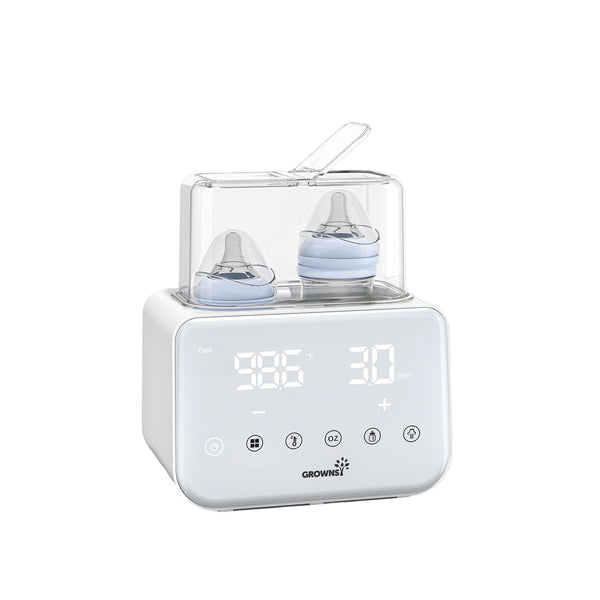
The GROWNSY Bottle Warmer is especially helpful for those middle of the night feedings while you are still weaning. It heats bottles quickly and consistently so you spend less time in the kitchen and get back to bed faster.
Sleep Training
Is It Too Late to Start Sleep Training at This Age?
No, not in the slightest. In fact, nine months is a common age for families to start sleep training, partly because the 9-month regression demands it.
While the AAP's safe sleep recommendations don't prohibit sleep training in healthy babies, a number of studies suggest that it doesn't harm infant-parent attachment.
Gentle Methods vs. Cry-It-Out: What Works at 9 Months
You can use either method. The more gentle methods, like the Ferber method, graduated extinction, or chair method, take longer but there is less crying. Full extinction, cry-it-out, tends to work faster.
The right way is the way you can do consistently. No matter which method you choose, inconsistency is one of the reasons sleep training stalls.
What to Do When Baby Stands Up in the Crib and Won't Lie Down
This is arguably the most common nine-month sleep training hurdle. Your baby stands up, can't get back down and screams. For the first few nights, go in and lay them down quietly with minimal interaction. Repeat as often as needed.
Most babies learn to lower themselves within a week. Practice sitting-to-lying during playtime throughout the day so their muscles are used to the movement when they are not frustrated and tired.

FAQs About 9-Month-Old Sleep
Is 8 PM Too Late for a 9-Month-Old's Bedtime?
Depends on wake up time. 8 PM bedtime is a little on the later side but manageable if your baby wakes at 7:00-7:30 AM. If they are waking at 6:00 AM, it’s likely they’re contributing to overtiredness. Not just starting the routine, the latest you should have your baby asleep is 8 PM.
Can I Let My Baby Cry It Out at Night at This Age?
If your baby is healthy and your pediatrician has given the green light, behavioral sleep methods are deemed appropriate at this age.
One of the key studies supporting the safety of behavioral interventions for infant sleep problems is a 2016 Pediatrics study by Gradisar et al. which examined behavioral interventions for infant sleep problems in a randomized controlled trial. That said, always check with your pediatrician first about the approach.
What Activities Help During Wake Windows at 9 Months?
Movement and exploration help nine-month-olds learn. Some activities to do during a good wake window are tummy time, practicing pulling up to stand at a low couch or table, stacking toys, simple peek-a-boo, and short walks outside.
Avoid high-stimulation activities like screens or rough play for the last 30 to 45 minutes before a nap or bedtime.
Building Sleep Habits That Last into the Toddler Years
The work you put into a solid 9 month old sleep schedule now pays forward. Nine-month-olds who learn to fall asleep on their own take those skills into toddlerhood. You want to establish habits like a consistent wake-up time, a predictable bedtime routine and sleep environment that your baby finds soothing on their own. It's okay if it's not perfect every night.
Travel happens, illness happens, and the GROWNSY Bottle Washer makes those sick-day, middle-of-the-night bottle cleanups much less painful. What matters is to get back to normal as quickly as possible.

Conclusion
Getting your 9 month old sleep schedule on track is hard but it's fixable. Know your wake windows, protect your nap schedule, establish a predictable routine for your baby, and have a plan for night waking. Most families who consistently do these things see a significant improvement within two weeks.
You are not doing it wrong. You are only in a tough phase with a baby who is growing faster than at almost any other time in their life. That’s a good thing even if it doesn’t feel like it at midnight.
Editor’s Recommendation
Grownsy Bottle Warmer:
Keeps nighttime feeds quick and calm. Heats milk or formula evenly without fuss so you can get everyone back to sleep faster during the night weaning phase.
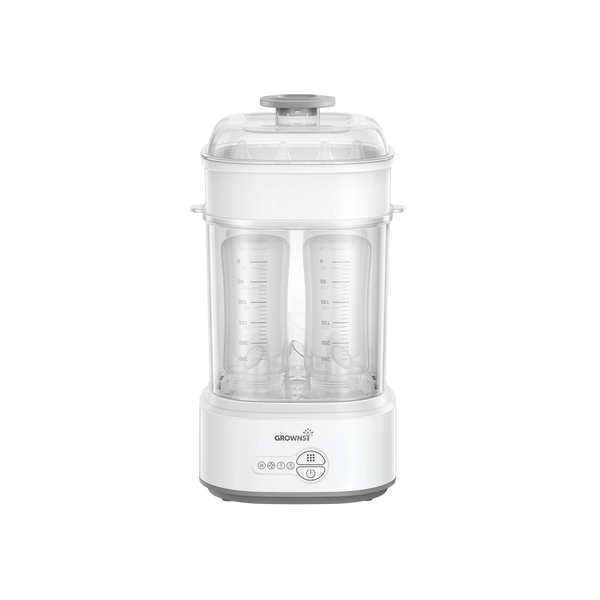
Grownsy Bottle Sterilizer & Dryer:
With multiple night feeds still in the picture at nine months, having bottles steam-sterilized and dried overnight means you start each morning with a clean set ready to go, without adding anything to your morning routine.
Grownsy Night Feeding Essentials Kit:
A practical bundle covering the key tools for nighttime feeding, warming, and hygiene, so you're not scrambling for what you need at 3 a.m.

Disclaimer
This article is intended for informational purposes only and does not replace professional medical advice. Always consult your pediatrician before making significant changes to your baby's sleep schedule, especially if you have concerns about their health, weight, or development.
Related Articles
1. All You Need to Know About 3-Month-Old Sleep Schedule
2. 10 Month Old Sleep Schedule: The Complete Parent's Guide
3. The Ultimate Guide to 8 Month Sleep Schedule


