


Five hours. Your baby just went five hours straight and you should be celebrating. Instead you're leaning over the bassinet with your hand hovering near their chest, waiting to see it move.
Everyone does this. And the question underneath isn't stupid, because there is a kind of newborn sleepiness that matters. Telling it apart from the ordinary kind turns out to be easier than it feels at 3am.
Table of Contents
Quick Answer
Fourteen to seventeen hours a day. Sometimes more. On its own that's almost never the problem.
The hours aren't what you're watching. You're watching whether they wake for feeds, whether the suck is strong, whether the wet diapers are stacking up, whether they're actually present during awake time. All four looking good means a sleepy baby is just a sleepy baby.
What matters is sleepiness that shows up alongside poor feeding, trouble waking, or a baby who suddenly isn't acting like themselves.
How Much Sleep Is Normal for a Newborn?

No single correct number exists. Hunting for one will just leave you feeling anxious. Here's the deal, if you're one of the many parents wondering, "can a newborn sleep too much"
Typical Newborn Sleep Over 24 Hours
Most newborns usually sleep between 14 & 17 hours, but to be honest, 18 or 19 hours on its own isn't worth getting too worked up about. They sleep in 2-4 hour chunks, all over the place (day and night) and disregard the clock completely.
Short naps are totally normal. Twenty minutes here, twenty minutes there, all day long. And of course, the odd three-hour stretch that has you frantically checking the monitor.
The First 24--48 Hours After Birth
The first two days are in a league of their own. Being born is exhausting for them too, and a lot of babies are pretty out of it.
Feeding is also still in the early stages. A breastfed baby might only take about a teaspoon the first day. That's supposed to happen, which is why frequency is more important than volume in those first few days.
Days 3--14: Short Sleep-and-Feeding Cycles
Week two is feeding central. Think 8 to 12 feeds in 24 hours, roughly every two to three hours day and night.
Sleep is total chaos. You won't find a pattern, because there isn't one yet.
Weeks 2--4: Longer Alert Periods but No Fixed Schedule
They're getting a bit more awake for longer periods of time, and you might even get some decent eye contact going on. But still, no schedule to speak of, and the night waking still continues.
Premature and Medically Fragile Babies Need Individual Guidance
Preemies sleep loads, sometimes up to 20 hours. And a lot of them are so sleepy that they'd rather not even feed unless you wake them up.
Were you a preemie, or has your baby got some ongoing medical issues? Forget the numbers above, whatever your pediatrician says is what really matters.
Why Feeding, Diaper Output, and Alertness Matter More Than One Sleep Number
Here's the thing: the total number of hours slept is just a pretty weak signal, all on its own.
Three things are way more important: Can they wake up for a feed and take it well? Are the poop diapers coming in at a good pace? And during the time they are awake, are they actually with it, and looking around, or just sort of existing?
Eighteen hours with all three going well? No problem. But fifteen hours with all three going poorly? That's a different story.
What Changes After the Newborn Stage (4--12 Months)
By around 4 months, you start to see a real shift in how your baby sleeps. Instead of those random 2-4 hour stints scattered throughout the day, most babies start to settle into a pretty consistent 10-12 hours of sleep at night, plus a couple of daytime naps.
Daytime naps start to look a bit more predictable and their overall sleep total drops to around 12-16 hours a day. The constant need to feed through the night also starts to wind down once your baby is growing well and the pediatrician has given the thumbs up for a bit more sleep.
This means that what used to be a major concern, a baby sleeping too much, has a whole new meaning. When your older baby is spending too many hours snoozing, it's usually not a big deal.
The most common reasons are that they're trying to shake off a minor bug, catching up on sleep after a busy day, or going through one of those annoying growth spurts or developmental leaps and just needs a bit of extra rest. All of this usually sorts itself out within a couple of days.
Still, one thing is worth keeping an eye on: the total amount your baby is sleeping during the day. Be careful not to let naps get too long. If you find that your baby is sleeping for more than 3 or 4 hours at a time, it's probably going to take it out of the night, and you'll end up with a little one who's bright eyed and bushy tailed at 2 am.
Common Reasons Newborns Sleep More Than Usual

Usually the explanation is dull.
Recovering From Labor, Delivery, or Medical Procedures
Long labor, forceps, C-section, certain medications during birth. Any of it can leave a baby drowsy for a few days. Circumcision or a heel prick can buy you a sleepy afternoon too.
Growth Spurts and Rapid Development
They cluster. Days 7 to 10, then around three weeks, then six. Pattern's usually the same: a stretch of nonstop feeding, then a stretch of nonstop sleeping. Resolves in a few days.
Day-and-Night Confusion
There's no circadian rhythm yet. Plenty of newborns sleep in long blocks during daylight and treat 2am as prime time.
Not a medical issue. Still needs managing though. Bright and noisy during the day, dim and boring at night, and don't let a long daytime sleep eat a feed.
Temporary Sleepiness After Vaccination
A sleepy day or two after shots is expected. What isn't expected is a baby who gets hard to wake, runs a fever in the first three months, or is still off after 48 hours. That's a call.
Medication-Related Drowsiness
Some medications your baby gets, and some that come through breast milk, cause drowsiness. If the sleepiness started after any medication did, on your side or theirs, mention it rather than waiting to see.
Sleepy or Lethargic? Warning Signs Parents Should Know
Here's the section that matters if you are eager to know "can a newborn sleep too much."
Normal Sleepiness Versus Lethargy
A sleepy baby responds to you. Unswaddle them, change them, pick them up, and they stir. Maybe complain. Come around enough to feed.
A lethargic baby doesn't. Stays floppy through all of it, or surfaces for a second and drops straight back under without eating. CHOP describes it as unusual drowsiness plus reduced response to sound and sight, and flags something important, that it often creeps in gradually. Which makes it hard to spot when you're with your baby every hour of every day.
One physical check worth knowing. Lift your baby with your hands tucked under their armpits. Normal tone, they hold. Low tone, they slide through your hands like a rag doll, head flopping sideways or back. That one gets a prompt call.
Being Difficult or Impossible to Wake
Run the usual playbook. Unswaddle, diaper, skin-to-skin, hands and feet.
Still can't get them awake enough to feed after real effort? That isn't a technique problem. Call.
Weak Sucking, Poor Feeding, or Repeatedly Missing Feeds
Latching then immediately dozing. A suck that feels weak or quits early. Taking a fraction of the usual. Sleeping through two feeds in a row.
Poor feeding is one of the earliest reliable warning signs there is in a newborn.
Fewer Wet Diapers and Other Signs of Dehydration
Diapers give you an actual number, which is rare in newborn care. AAP guidance puts it at 2 to 3 wet ones daily the first few days, then at least 5 to 6 from around day four or five. Four or more stools daily by day four.
Other dehydration flags: no urine in over eight hours, dark urine, very dry mouth, no tears, sunken soft spot.
Worsening Jaundice or Unusual Skin Color
Four out of five newborns get jaundice and it's usually harmless. It starts at the face and travels down, so where it stops is informative. Face only, generally fine. Reaching the chest, eyes, belly, arms or legs means the level needs checking.
Call if the yellow is deepening, spreading downward, hitting the whites of the eyes, or showing up in a baby who's hard to wake or feeding badly.
Blue or grey anywhere on the skin, lips, or face is an emergency.
Abnormal Breathing, Limpness, or Reduced Responsiveness
Flaring nostrils. Grunting on every breath. Skin sucking in between the ribs. Breathing too fast, or with long gaps. Any of that plus limpness or a weak cry needs urgent care.
A Rectal Temperature of 100.4°F (38°C) or Higher
Under three months, this is an emergency. Not a morning call. Not wait and see.
And here's the part almost nobody tells parents. Fever shows up in fewer than 10% of newborns with sepsis. The early signs are usually reduced activity, weaker sucking, poor appetite. That's it.
So no fever doesn't mean no infection. Not in the newborn period. A baby who's suddenly much sleepier and feeding badly needs attention whether or not there's a temperature.
When to Call the Pediatrician and When to Seek Emergency Care
Emergency: rectal temp of 100.4°F or higher under three months, blue or grey skin, breathing that looks like effort, limpness, unresponsiveness, or a baby you can't wake.
Same day: repeatedly missing feeds, wet diapers dropping off, jaundice spreading or deepening, weak sucking, or a clear shift from how your baby usually is.
That last one counts more than people think. Nobody knows your baby's baseline like you do. A sudden departure from it is real information, even when you can't put your finger on what changed.
When Should You Wake a Newborn for Feeding?

Just like you are conscious of the query "can a newborn sleep too much?", you should also be careful of when to wake the baby for a feed.
During the First Weeks and Before Birth Weight Is Regained
Rule of thumb, no more than four hours at night without a feed. Every two to three hours during the day.
Holds most strictly until they're back at birth weight, usually somewhere in the first fortnight.
When Your Baby Is Premature, Has Jaundice, or Has a Medical Condition
Three groups you wake without hesitation. Babies not yet back to birth weight. Babies with jaundice. Babies born early.
The jaundice one deserves an explanation, because it's a loop and nobody ever describes it as one. Bilirubin makes them sleepy. Sleepy means feeding less. Milk is literally what carries bilirubin out of the body, so less feeding means less clearance. Less clearance, deeper jaundice. Deeper jaundice, sleepier baby. Round and round.
Waking a jaundiced newborn isn't only about calories. It's part of the treatment.
Feeding Frequency for a Sleepy Newborn
Breastfed, at least 8 to 12 feeds in 24 hours. AAP guidance links feeding fewer than eight times daily to higher bilirubin. If there's jaundice, tighten it: every hour and a half to two hours during the day, targeting ten feeds or more.
Formula, every two to three hours, eight feeds minimum in 24 hours. Half an ounce the first day or two, then one to two ounces, reaching three or four by the end of month one.
Sleepy babies take small amounts and conk out. Frequency is what makes up for it.
When a Healthy, Growing Baby May Be Allowed to Sleep Longer
Once they're above birth weight, gaining steadily, feeding well, plenty of diapers, longer night stretches usually become fine.
That's your pediatrician's call though. Ask at the next visit rather than deciding it yourself at 4am.
How to Safely Wake a Sleepy Newborn
Gentle, and escalating in roughly this order.
Incorporate REM Sleep Observation into Waking Techniques
Before you even think about trying anything, just watch them for a moment. Timing is way more important than having the right technique here.
Newborns cycle between active sleep and deep sleep, and waking a baby out of deep sleep is genuinely difficult and unpleasant for both of you. Wait for active sleep and half the work is already done.
The signs are pretty subtle but they're always there. Eyelids start to flutter. You can see their eyes moving just beneath the lids. Their face might give a tiny little twitch or even look like they're smiling for a split second. You might see some gentle movement in their arms or legs. Their breathing gets all clunky and uneven instead of that nice steady slow rhythm of deep sleep.
Catch them in that window and unswaddling or a diaper change will usually be enough. Try the same thing ten minutes earlier, while they're limp and unresponsive, and you'll work much harder for a worse result. If your baby is deeply out, waiting five or ten minutes for the next active phase often costs you less time than fighting it.
Unswaddle and Change the Diaper
Start here. Unwrapping alone does it for a lot of babies since the temperature shift registers immediately. A diaper change works especially well on the ones who fall asleep mid-feed, and it works even when the diaper's dry.
Skin-to-Skin Contact and an Upright Hold
Down to the diaper, onto your bare chest. Skin-to-skin wakes them and triggers feeding instincts at the same time, which is a useful two-for-one.
Going from flat to upright against your shoulder helps too.
Gently Rub the Back, Hands, or Feet
Rub the back. Stroke a cheek. Move their arms and legs around. Tickle the soles of their feet. Talk or sing while you're doing it. Several small inputs beat one big one.
Keeping a Sleepy Baby Engaged Mid-Feed
Breastfeeding: compress when the sucking slows, and switch sides more than you normally would. Swallowing pace drops, switch.
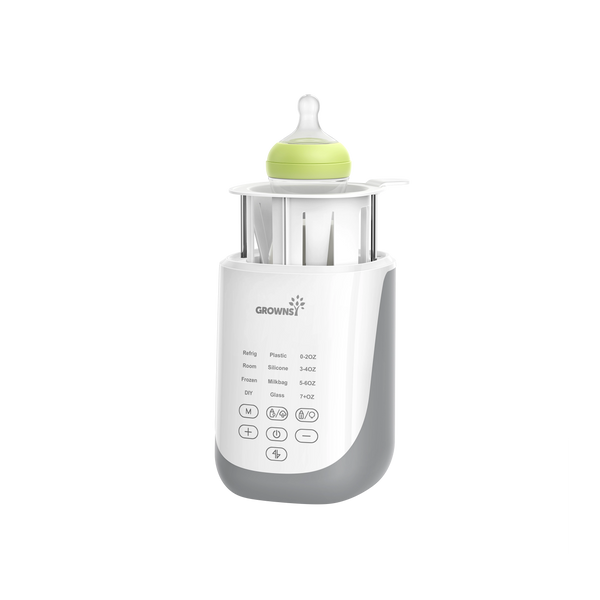
Bottle: stop, sit them upright, burp. Resets them enough to get more down. Speed matters here too, because a warm bottle in two minutes means you haven't lost your window standing at the stove. The Grownsy 10-in-1 Fast Baby Bottle Warmer does it in under three with proper temperature control.
Never Shake, Startle, or Use Cold Water to Wake a Baby
Search around long enough and someone will suggest ice cubes on the feet or a splash of cold water. Don't.
Never shake a baby. Not for this, not for anything. No ice, no cold water, no sudden loud noises to jolt them. Gentle methods failing is your signal to phone the pediatrician, not to try something harder.
What to Do if Your Baby Still Will Not Wake or Feed
You've tried everything and they still won't rouse enough to eat. That's your answer. Pediatrician or urgent care.
Breastfeeding? Hand express or pump while you sort it, so your supply doesn't take the hit.
Is Your Sleepy Newborn Getting Enough Milk?
Sleep hours are a bad measure. Intake is the good one, and you can actually count it.
Effective Sucking and Swallowing
Look for rhythmic sucking with swallows you can hear, not just fluttering at the nipple. Feeds long enough to count for something. A baby who seems settled afterward rather than still searching.
Feeding Frequency Over 24 Hours
Eight to twelve breastfeeds, or eight-plus bottles. Count across the whole day. Don't judge it off one weird stretch.
How Wet Diaper Counts Change During the First Week
Two to three wet daily the first few days. At least five to six from day four or five on. Four or more stools daily by day four.
Coming up short is worth a call, especially alongside extra sleepiness.
Weight Loss, Regaining Birth Weight, and Ongoing Growth
They lose weight at first. Normal. Losing more than 10% of birth weight by day five is not, and it points at intake.
Most are back to birth weight around day 10 to 14.
When to Contact a Pediatrician or Lactation Consultant
Call if diapers are low, weight isn't tracking, feeds feel useless, or your baby's too sleepy to eat properly. A lactation consultant genuinely helps here. Ask early instead of treating it as a last resort.
Safe Sleep Guidelines for a Newborn Who Sleeps a Lot

More sleep means more hours in the sleep space. Which makes the setup matter more, not less.
The Non-Negotiables
Back for every sleep, naps too. Firm, flat, safety-approved surface. Fitted sheet and baby, nothing else, so no blankets or pillows or positioners or bumpers or toys.
Same room, separate surface, first six months. A bedside bassinet like the Grownsy 5-in-1 Bedside Sleeper keeps them in arm's reach for night feeds, and the six height settings mean you can get it level with your mattress. More on getting a newborn to actually sleep in one.
Move a Sleeping Baby Out of Car Seats, Swings, and Inclined Products
Babies fall asleep in these things all the time ... and it's just not a good idea. None of those things is a safe place for a baby to be sleeping, and the risk gets even higher if your little one is super sleepy and can't even roll over on their own.
Get there, move them to something flat. Inclined sleepers over 10 degrees are federally banned in the US now, though plenty still float around secondhand.
Swaddle Safely and Stop at the First Signs of Rolling
You want to swaddle your baby snug up tight at the arms and loose at the hips, so their legs can bend up and out. And it all has to be on their back.
And then there's the part where you stop at the first sign that they're trying to roll over, not after they've already figured it out, but before. So what exactly do you look out for to know it's time to stop?
Use Feeding and Sleep Cues Instead of a Rigid Newborn Schedule
Don't schedule a newborn. Follow cues, wake for feeds when the clock says so, let the rest be a mess. Structure shows up later without your help.
Use a 24-Hour Sleep and Feeding Log
Worried? Stop trying to remember and start writing it down. Two days of notes turns a vague bad feeling into something a pediatrician can work with.
What to Record
Sleep, start and end. Every feed with time, length, rough amount. Wet diapers and stools. Any temperature you take. And a line on awake time, whether they were properly engaged or just briefly conscious.
Paper stuck to the fridge works as well as any app.
Share Meaningful Changes With Your Pediatrician
Bring it to the appointment. Patterns beat one frightening night by a mile, and a log means your pediatrician sees the trend instead of relying on your memory when you've had nine hours of sleep in four days.
Conclusion
Can a newborn sleep too much? Sometimes and weirdly, it's not really about the number of hours either. The hours themselves aren't the problem.
You should be watching for three things instead. Are they waking up to eat and actually eating what they need? Are their diapers adding up at a normal rate? Are they showing real signs of alertness when they're awake, instead of just lying there like a lump? If all those things are happening, then 18 hours of sleep is probably just normal.
The thing is, an extra 3-4 hours of sleep alongside things like the baby not feeding properly or not being able to wake up, or if the baby just seems totally off, is a big red flag. A fever in babies under three months, or any of the other signs of trouble like blue skin or breathing issues, let alone if you just can't get the baby to wake up at all - that is an emergency situation.
And truthfully, if something just feels off and you can't put your finger on why, just pick up the phone and talk to your pediatrician.
Related Articles
1.Best Bassinets and Cradles how to choose
2.Is the DreamNest Bassinet worth it
3.Baby Won't Sleep in Bassinet
Reference
-
American Academy of Pediatrics, HealthyChildren.org. How Often and How Much Should Your Baby Eat?\ https://www.healthychildren.org/English/ages-stages/baby/feeding-nutrition/Pages/how-often-and-how-much-should-your-baby-eat.aspx
-
American Academy of Pediatrics, HealthyChildren.org. Jaundice in Newborns.\ https://www.healthychildren.org/English/ages-stages/baby/Pages/jaundice.aspx
-
American Academy of Pediatrics. Clinical Practice Guideline Revision: Management of Hyperbilirubinemia in the Newborn Infant 35 or More Weeks of Gestation. Pediatrics, 2022.\ https://publications.aap.org/pediatrics/article/150/3/e2022058859/188726/Clinical-Practice-Guideline-Revision-Management-of
-
American Academy of Pediatrics. Conditions Often Associated With Breastfeeding.\ https://www.aap.org/en/patient-care/newborn-infant-and-early-childhood-nutrition/conditions-often-associated-with-breastfeeding/
-
American Academy of Pediatrics. Sleep-Related Infant Deaths: Updated 2022 Recommendations. Pediatrics.\ https://publications.aap.org/pediatrics/article/150/1/e2022057990/188304/Sleep-Related-Infant-Deaths-Updated-2022
-
Children's Hospital of Philadelphia. Behavior Changes to Watch For in a Newborn.\ https://www.chop.edu/conditions-diseases/behavior-changes
-
Centers for Disease Control and Prevention. Jaundice and Breastfeeding.\ https://www.cdc.gov/breastfeeding-special-circumstances/hcp/illnesses-conditions/jaundice.html
-
Seattle Children's Hospital. Jaundiced Newborn.\ https://www.seattlechildrens.org/conditions/a-z/jaundiced-newborn/
-
American Academy of Family Physicians. Hyperbilirubinemia in Newborns: Updated Guidelines From the AAP.\ https://www.aafp.org/afp/2023/0600/practice-guidelines-hyperbilirubinemia-newborns
-
La Leche League GB. Sleepy Baby: Why and What To Do.\ https://laleche.org.uk/sleepy-baby-why-and-what-to-do/
-
La Leche League International. Newborn Breastfeeding Frequency.\ https://llli.org/breastfeeding-info/frequency-feeding-frequently-asked-questions-faqs/
-
Cleveland Clinic. 15 Signs That Your Baby Is Tired.\ https://health.clevelandclinic.org/how-can-i-tell-when-my-baby-is-tired


