


It's 2am. You've been rocking for forty minutes. Your baby is finally out, properly out, mouth open and everything. You lower them into the bassinet with the precision of a bomb disposal technician. Their back touches the mattress. Eyes open. Screaming.
If that's your night, you're in extremely good company. This is one of the most common newborn problems there is, and it's usually fixable.
Quick Answer
Most newborns are just freaked out by the bassinet. It's a pretty drastic change from the womb (no warmth, no swaying, no heartbeat to rattle on). It's not because the bassinet is not good enough, it's just that your baby is still getting used to being outside, that's all.
The fix is usually a combination of getting their sleep environment right, learning to handle the startle reflex, and how you actually get them from you to the bassinet. Most babies get a whole lot better at this by the time they hit 8 to 12 weeks.
Why Your Baby Won't Sleep in Bassinet
Before you try to fix it, worth knowing which thing you're actually dealing with.

| What you're seeing | What's likely behind it | Where to start |
|---|---|---|
| Wakes the second their back touches down | Startle reflex plus temperature change | Swaddle, warm the sheet, feet-first transfer |
| Sleeps 20 minutes then wakes crying | End of a sleep cycle, not a bassinet problem | Wait 60 seconds before intervening |
| Fights sleep, then screams inconsolably | Overtired, missed the window | Shorter wake windows, watch early cues |
| Arches and grunts after feeds | Gas or reflux | Longer burping, upright time before laying down |
| Sleeps fine on you, never in the bassinet | Wants containment and your smell | Practice naps, sheet that smells like you |
Normal Newborn Sleep Cycles and Active Sleep
Newborns sleep in short little chunks, 40 minutes, maybe 60. Adults sleep for about double that. And let's be honest, a lot of what happens in those tiny chunks is just your baby acting out.
It's not exactly sleep, it's more like active sleep (twitching, grunting, eyelids all over the place, the odd yell). Sounds like a lot like a baby waking up, right?
The problem is that almost everyone makes the same mistake at least a dozen times over. A baby makes a noise, you freak out, and you pick them up straight away. But the thing is, they were sleeping; now they're wide awake.
Hang on a minute before you pick them up; wait until the count of 60 or something. A whole lot of babies will sort themselves out and just drop back off if nobody intervenes.
The Startle Reflex and Preference for Being Held
The Moro reflex is what's behind that flailing arm and jolt of being wide awake when you feel like you're falling. In your arms, they're all safe and contained, and in an open bassinet, it's a free-for-all.
And it gets worse, your baby's got their own view of what the perfect sleeping spot looks like, and it's your chest (nice and warm, all the movement and the sounds). The bassinet is just flat, and that's a pretty big downgrade.
Hunger, Diaper Needs, and Temperature Discomfort
Run the basics first. Room temperature should sit between 68 and 72°F. Check the back of their neck rather than hands or feet, which run cool on almost every baby and tell you nothing.
Overtiredness, Undertiredness, and Newborn Sleep Cues
Newborn wake windows are short, usually 45 to 90 minutes including the feed. Miss that window and cortisol rises, which makes settling harder. Overtired babies fight sleep hardest.
Early cues are subtle. Staring into space, a glazed look, red eyebrows, turning away from stimulation. By the time you get eye rubbing and yawning, you're already late.
Gas, Reflux, Congestion, or Illness
If your baby settles fine but wakes twenty minutes later arching and grunting, look at what's happening physically. Gas, reflux, and a stuffy nose all get worse lying flat. Not a reason to change their sleep position, but it does mean the fix happens before they go down.
Set Up a Safe and Comfortable Bassinet Environment

Some of what makes sleep safe also makes it harder, and it's worth naming that. Flat and firm is safer than soft and inclined. It's also less cozy. Both things are true.
Here's what to do if your baby won't sleep in bassinet:
Use a Firm, Flat, Level Mattress With a Fitted Sheet
Give the mattress a firm press, does your hand sink right in? If so, it's way too soft. Firmness might feel wrong to you but it's right for their airway. Check the edges too.
Make sure the mattress doesn't have any gaps around the frame. And then there's the sheet, which needs to be tight (and tight enough that pressing on it doesn't make it slide around).
Keep Pillows, Blankets, Positioners, Toys, and Bumpers Out
Nothing in the bassinet except a fitted sheet and your baby. It looks stark and slightly sad. Stark is the point.
Crib bumpers, worth knowing, are now federally banned in the US. Not discouraged, banned. They were linked to at least 107 infant deaths between 1990 and 2016.
Place Your Baby on Their Back for Every Sleep
Every single sleep session, no exceptions, until they can roll both ways on their own. Babies do tend to settle in faster on their tummies, and your paediatrician will tell you the same. But that makes it no safer.
Use an Approved Bedside Bassinet for Room-Sharing Without Bed-Sharing
The first six months of room-sharing without actually bed-sharing is the way to go. And that's where a good bassinet really earns its keep. Bedside models sit right up against your bed so you can do night feeds without ever having to get out of bed, and the transfer from one to the other becomes almost non-existent.
Height matching is more important than people give it credit for. If the bassinet is set lower than your bed, you end up putting your baby down at an awkward angle, which is basically guaranteed to wake them.
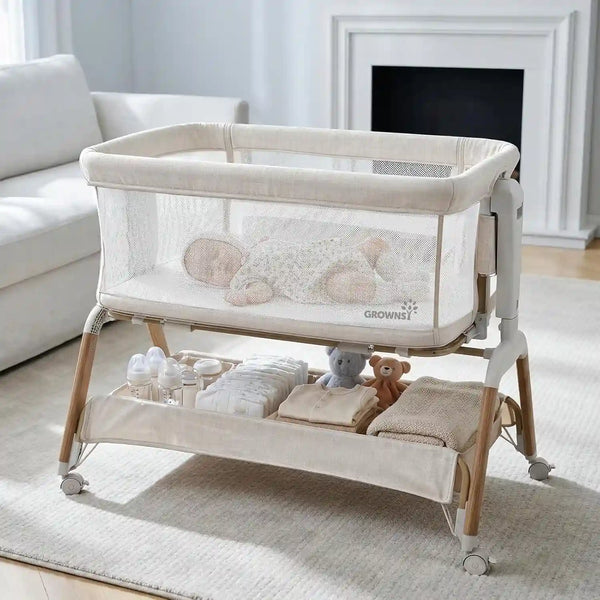
The Grownsy 5-in-1 Bedside Sleeper has six height settings for that reason, plus full mesh sides for airflow and a gentle rocking mode. It converts to a portable crib later.
Avoid Inclined Sleepers, Wedges, and Recalled Sleep Products
Something a lot of parents still don't know. In 2022, an entire category of baby sleep products got wiped off the US market.
Inclined sleepers, the rockers and nappers that hold a baby at an angle, are banned outright. Anything marketed for infant sleep has to have a surface angle of 10 degrees or less.
Manage Light, Room Temperature, and White Noise Safely
Dark helps. White noise helps too, played continuously at moderate volume with the machine well away from the bassinet, not clipped to the side.
On temperature, one light layer more than you're comfortable in. Overheating is a real risk, so err cooler. Breathable mesh sides help, since they let air move rather than trapping it.
Swaddling, the Startle Reflex, and Gentle Settling Techniques
If the startle reflex is what's waking your baby, swaddling is the highest-leverage fix available.
Swaddle Snugly While Leaving Room for Hip Movement
Snug across the arms and chest is important, but you need to leave a bit of room for hip movement. Think of it like this: snug enough that it feels cozy, but loose enough that their legs can bend up and out.
Wrapping that swaddle too tightly down the legs can put some pretty pressure on your baby's hips, so don't do that. Instead, aim for a fit that lets you fit two or three fingers between the swaddle and their chest.
Swaddle Safety Rules That Don't Bend
A swaddled baby always has to go on their back, no exceptions. Never on their side, never on their tummy. If a swaddled baby ends up face down, they won't be able to free up their arms to push themselves back up.
And when it comes to stopping swaddling, don't wait until your baby's already mastered the art of rolling over. Keep an eye out for signs like arching, hip twisting, hard kicking, or trying to break free from the swaddle.
Those are the same signals that'll start to show up when they start working on rolling over when babies start working toward rolling over.
Avoid Weighted Swaddles and Switch to an Appropriate Sleep Sack
Weighted swaddles and sleep sacks aren't recommended, and with good reason: anything that adds pressure to a newborn's chest can affect their breathing, and babies can't just push it off. When the swaddle comes off, it's time to switch to a sleep sack that lets their arms move free.
Offer a Pacifier Safely if Your Baby Accepts One
If your baby takes a pacifier, great! Using one during sleep has been linked to a reduced SIDS risk. Just be sure to offer it safely, and if it falls out once they're asleep, leave it be.
How to Move Your Baby From Your Arms to the Bassinet

This is where most nights fall apart. Technique genuinely matters more than luck here.
Build a Short and Consistent Pre-Sleep Routine
Pick an order and don't deviate from it. Diaper, swaddle, feed, lights down, white noise on, bassinet. Ten minutes is plenty. It's not about length, it's about the sequence staying the same.
Choose a Calm Transfer Moment Without Forcing "Drowsy but Awake"
You'll have seen the advice in just about every sleep article out there: put your baby down drowsy but awake. But for a lot of newborns, that just doesn't work, and chasing it can actually make the night worse.
For the first few months, it's totally fine to just fully calm your baby down and transfer them asleep. You can work on getting them to drowsy-but-awake later on, usually around two to three months. But for now, just focus on getting them safely to their bed.
And one more thing: don't worry if they don't take right away. Deep sleep has some pretty clear signs: limp arms, unclenched fists, slow steady breathing. Just wait for those, and you'll know they're good to go.
Lower the Feet and Bottom Before the Shoulders and Head
Most people naturally try to lower their baby down with their head leading the way, but actually, that's the worst way to do it. Instead, try it this way: feet and bottom first, then the back. Head and shoulders last, and be sure to keep one hand under their head and neck the whole way down.
Support the Head and Neck Throughout the Transfer
One hand stays under the head and neck the whole way down. Don't let the head flop back. Just move at a pace that's almost too slow, it's a good test to see if you can keep it down there.
Keep a Hand on the Chest Before Slowly Removing It
Once they're down, don't leave. Rest a hand firmly on their chest for thirty seconds to a minute. That pressure holds the containment feeling a little longer.
Then fade it out over several seconds rather than lifting. Yanking your hand away is a common last-second mistake.
Practice With One Bassinet Nap or Calm Awake Session Each Day
If the bassinet is always a source of stress at 2am, that's the only thing your baby is going to think it's about.
Try a daytime nap in it, when no one is a wrung-out mess yet. And put them in it when they're awake and happy for a bit at a time. Keep it low-key, same idea as letting a baby get used to an empty bottle before you put any milk in it.
Reduce Soothing Gradually and Expect Progress to Take Time
This takes weeks, not just two or three nights. Most babies get a lot better around 8-12 weeks as their startle reflex starts to fade. Phasing out soothing gradually is key, like from rocking to sleep all the way down to just patting in the bassinet.
Reflux, Congestion, and Age-Specific Sleep Challenges
Sometimes the bassinet isn't the problem. Something physical is making lying flat uncomfortable.
Feed and Burp Your Baby Before Sleep
Burp longer than feels necessary. Two or three minutes upright minimum. A trapped bubble that surfaces ten minutes after you've laid them down undoes the whole transfer.
Keep a Baby With Reflux Upright While Awake, Then Use Flat Back-Sleeping
Hold them upright for 20 to 30 minutes after feeds, that's the fix. You can do it while they're awake and you're watching over them. Then they're still sleeping on their back just like always. Reflux doesn't mean you have to change the way they sleep.
Never Elevate the Bassinet Mattress or Add a Sleep Positioner
Nothing goes under that mattress. Not a towel, not a folded blanket, not a stack of books, definitely not a wedge.
Here's why it matters so much. Tilt the surface and a baby slides down it. They end up chin pressed to chest, which shuts the airway, and they haven't got the neck strength to fix it. No struggle, no noise. That's the whole mechanism behind the inclined sleeper deaths that got the category banned.
Use Saline, Gentle Suction, or a Cool-Mist Humidifier for Congestion
Young babies breathe almost entirely through their nose, so mild congestion wrecks sleep. So a little mucus that wouldn't register for you completely wrecks their night.
Two saline drops, wait a moment, then suction. Whole thing takes about three minutes, and the difference is immediate.
Adjustable suction matters, since a newborn needs far less pressure than a four-month-old. The Grownsy SniffEase Nasal Aspirator has three levels and soft silicone tips. If you're unsure whether it's congestion or something else, this guide to noisy baby breathing covers the difference.
Adjust Expectations From the Newborn Stage to the 3--4-Month Sleep Change
Around three to four months, sleep architecture matures into clearer cycles with lighter waking between them. This is permanent, not a phase. A baby who was finally sleeping well can suddenly start waking constantly, and it isn't a bassinet problem. Worth knowing before it happens, alongside the other changes that land around this age.
Red Flags That Need a Pediatrician
Call for a fever in a baby under three months, which is an automatic same-day call at that age. Also for breathing that looks like work, meaning flaring nostrils, grunting with each breath, or skin pulling in between the ribs. Any blue or grey tint around the lips is an emergency.
Beyond that, flag persistent feeding refusal, poor weight gain, projectile vomiting, a baby who seems unusually limp or hard to wake, or inconsolable crying that doesn't fit their usual pattern. Trust your read. Pediatricians would rather field the question.
A Safe Sleep Plan for Exhausted Parents

Here's a plan for parents who are worried that the baby won't sleep in bassinet:
Place Your Baby Safely in the Bassinet if You Feel Overwhelmed
If you're at your limit's end, put your baby down on their back and step out for a few minutes to grab a breather, have a cup of coffee, or just stand outside the room for a bit. A crying baby in a safe sleep environment is not an issue. A baby in your arms and you getting all drowsy upright, now that's a point of concern.
Avoid Falling Asleep With Your Baby on a Sofa, Recliner, or Adult Bed
Sofas and recliners are not recommended places for a baby to sleep. Babies get wedged in between cushions and your body and the back of the couch, and you can't even see it coming.
The thing is, nobody means for it to happen. You sit down at 3 am to feed, just for a minute, and before you know it, you're out cold. If you feel like that's about to happen, move to your bed first, clear the pillows and blankets off, and get your baby back in the bassinet once you wake up.
Use Partner Shifts and Accept Help From Trusted Caregivers
Split the night into blocks. One of you covers until 2, the other takes it from there. Four hours straight beats seven broken ones, and it isn't close.
Someone offers to take the baby for a morning so you can sleep? Say yes. Don't do the thing where you insist you're fine.
Know When to Seek Postpartum Mental Health Support
Exhaustion and postpartum mood stuff feed each other. From the inside it's almost impossible to tell which one started it.
Reach out if you're hopeless most days, anxious in a way that doesn't switch off, weirdly disconnected from your baby, or getting thoughts that scare you. None of that means you're failing at this.
Conclusion
Your baby won't sleep in bassinet and you've probably decided that means something. It usually doesn't. They're just not used to sleeping flat on their back after 9 months of being all snuggled up and warm and wobbly.
So, work at getting it sorted. Start with the environment, then try and get the startle reflex under control, and then get a system in place for putting them to bed. Feet go in first, hand on the chest, and then let go slowly.
Try getting a nap in there during the day when it won't kill you if they don't sleep. And whatever some well-meaning person tells you to try, don't bother with anything that props them at an angle to help them sleep better.
Somewhere around 8 to 12 weeks this gets better on its own. Until it does, guard your own sleep like it counts. It does.
Related Articles
1.Best Bassinets and Cradles how to choose
2.Is the DreamNest Bassinet worth it
Reference
-
U.S. Consumer Product Safety Commission. Inclined Sleepers Business Guidance, 16 CFR Part 1310.
-
U.S. Consumer Product Safety Commission. Infant Sleep Products Business Guidance.
-
American Academy of Pediatrics, HealthyChildren.org. A Parent's Guide to Safe Sleep.
-
American Academy of Pediatrics, HealthyChildren.org. Swaddling: Is It Safe?
-
National Institutes of Health, PMC. Sleep Physiology and Sleep Disorders in Childhood.


