


A bedside sleeper and a traditional bassinet can both provide a dedicated sleep space for a newborn, but they are designed for slightly different parenting routines.
A traditional bassinet is usually a standalone sleep space that can be placed near the parent's bed or moved around the home. A bedside sleeper is specifically designed to sit next to the adult bed, often with adjustable height and a side panel that provides easier access to the baby.
For parents who expect frequent nighttime feeding and want their newborn within easy reach, a bedside sleeper can be more convenient. For families who prioritize portability or want a simple standalone sleep space, a traditional bassinet may be enough.
The right choice depends less on which type is "better" and more on how you plan to use it every night.
Bedside Sleeper vs. Traditional Bassinet: What's the Difference?
The main difference is how the bassinet fits into your nighttime routine.
A traditional bassinet focuses primarily on providing a compact sleep space.
A bedside sleeper goes one step further by integrating that sleep space into the parent's nighttime setup.
| Feature | Bedside Sleeper | Traditional Bassinet |
|---|---|---|
| Designed next to adult bed | Yes | Not necessarily |
| Adjustable height | Common | Varies |
| Easy bedside access | Yes | Limited |
| Side panel access | Common | Usually not |
| Secure bed attachment | Common | Usually not |
| Easy to move around home | Some models | Often easier |
| Best for frequent nighttime feeding | Yes | Depends on design |
| Standalone use | Often | Yes |
1. Bedside Access
This is probably the biggest difference between the two.
A traditional bassinet typically has fixed sides. When your baby wakes up, you usually need to sit up, reach over the side, or get out of bed to pick them up.
A bedside sleeper is designed to reduce that distance.
Many models include a lowerable side panel, allowing parents to reach the baby more easily from the bed while maintaining a separate sleep surface.
This can be particularly useful during the newborn stage, when nighttime wake-ups can happen several times a night.
Best for:
- Bedside sleeper: Parents who want their baby within easy reach.
- Traditional bassinet: Parents who don't mind having a little more separation between their bed and the baby's sleep space.
 2. Nighttime Feeding and Soothing
Newborn care doesn't stop when the lights go out.
Parents may need to feed, burp, change, soothe, or simply check on their baby throughout the night.
A bedside sleeper can make these routines more convenient because the baby is positioned directly next to the adult bed.
This can be especially helpful for parents who are breastfeeding or recovering from childbirth, when repeatedly getting up and walking across the room can become physically demanding.
A traditional bassinet can still work well for nighttime feeding, particularly if it is positioned close to the bed. However, it generally doesn't provide the same level of direct bedside access.
3. Height Adjustment and Bed Alignment
Another important distinction is height.
Adult beds come in different heights depending on the mattress, bed frame, and overall design.
A traditional bassinet may have a fixed sleeping height, which means there is less flexibility in how it aligns with your mattress.
Bedside sleepers often offer multiple height settings so parents can create a closer fit with their bed.
When comparing models, look for:
- Multiple height levels
- A sufficient adjustment range
- Secure locking at each height
- A stable frame after adjustment
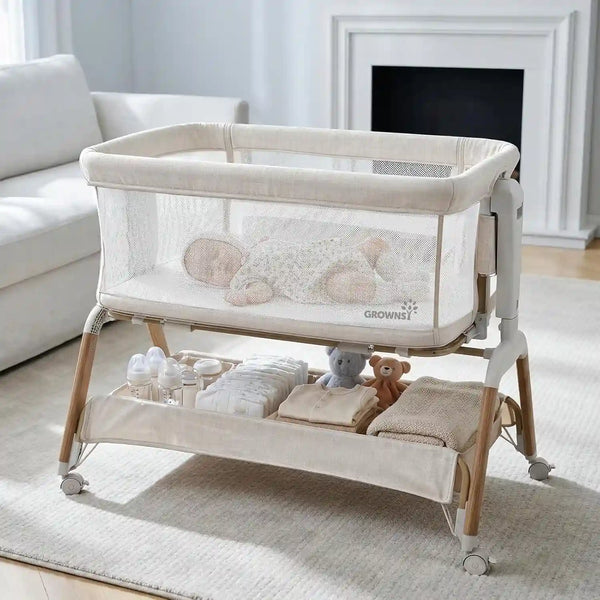
The Grownsy DreamNest Bedside Bassinet offers 6 height settings from 60--72 cm, allowing parents to adjust the bassinet to better match their bed.

4. Stability and Secure Attachment
Being close to the adult bed is convenient, but the setup also needs to remain stable.
A bedside sleeper typically uses an attachment system to secure the bassinet to the adult bed.
This helps prevent unwanted movement and keeps the bassinet positioned correctly beside the mattress.
A traditional bassinet generally stands independently and does not need to be attached to the bed.
Neither approach is automatically better. The important consideration is whether the product is designed and used according to the manufacturer's instructions and whether the sleep space remains stable and appropriate for your baby's stage of development.
5. Breathability and Visibility
This is one area where the two types can be quite similar.
Whether you choose a bedside sleeper or a traditional bassinet, breathable materials and good visibility are valuable features.
Look for:
- Breathable mesh sides
- Clear visibility from the parent's sleeping position
- A stable frame
- A firm, flat sleep surface
For example, Grownsy DreamNest uses 360° breathable mesh, allowing parents to see their baby from multiple angles while supporting airflow around the sleep area.
The important point is that breathability is a product feature, not a substitute for safe sleep practices.
6. Portability Around the Home
This is where a traditional bassinet may have an advantage.
If you want to move your baby's sleep space frequently between the bedroom, living room, or other areas of the home, portability can become a priority.
Many traditional bassinets are designed as lightweight standalone units.
Some bedside sleepers also include wheels, allowing parents to move them around the home.
The difference is that a bedside sleeper usually prioritizes bedside functionality first, while a traditional bassinet may prioritize simple portability and standalone use.
If mobility is important to you, look for smooth-rolling wheels and reliable wheel locks.

7. Which One Is Better for Nighttime Parenting?
If your biggest concern is making nighttime care easier, a bedside sleeper generally has an advantage.
Consider a typical newborn night:
Your baby wakes. You need to check on them. You feed them. You soothe them. You put them back down. Then you try to get back to sleep.
With a bedside sleeper, many of these steps can happen without fully leaving the bed. That's the main reason parents choose this type of bassinet.
A traditional bassinet can still provide a comfortable sleep space, but it may require slightly more movement between the parent's bed and the baby's sleep space.
Bedside Sleeper vs. Traditional Bassinet: Which Should You Choose?
Choose a bedside sleeper if:
- You expect frequent nighttime feeding.
- You want your baby within easy reach.
- You plan to room-share.
- You want adjustable height.
- You prefer a bassinet that attaches securely to the adult bed.
- You want to reduce unnecessary movement during nighttime care.
Choose a traditional bassinet if:
- You mainly want a simple standalone sleep space.
- You plan to move the bassinet frequently around your home.
- Bedside access isn't a major priority.
- You prefer a more straightforward design.
- You already have a sleep setup that works well for your nighttime routine.
There isn't one universal answer. The better option depends on what you need most from your baby's sleep space.
Where Does a Bedside Bassinet Like Grownsy DreamNest Fit?
The Grownsy DreamNest Bedside Bassinet is designed for parents who want more than a standalone sleep space.
Its core design combines:
- 6-level height adjustment (60--72 cm)
- Bedside sleeper mode
- Secure attachment system
- 360° breathable mesh
- Gentle parallel rocking
- Rock & Lock stability
- Lockable wheels
- Integrated storage
- Double-sided mattress
The idea is to bring these functions together around one central need: making nighttime care easier while keeping your baby close.
Instead of choosing between bedside access and everyday mobility, DreamNest is designed to provide both.
Frequently Asked Questions
Is a bedside sleeper safer than a traditional bassinet?
Neither type is automatically safer simply because of its category. Safety depends on the specific product's design, construction, instructions, and how it is used.
Whichever type you choose, prioritize a firm, flat sleep surface, stable construction, breathable materials, and appropriate use according to the manufacturer's instructions.
Can a traditional bassinet be used beside the bed?
Yes. A traditional bassinet can be placed near the parent's bed if it is designed for that use and positioned according to the manufacturer's instructions.
The main difference is that a bedside sleeper is specifically designed to provide closer access and, in many cases, secure attachment to the adult bed.
Is a bedside sleeper worth it for breastfeeding?
For parents who breastfeed frequently during the night, a bedside sleeper can make nighttime routines more convenient by keeping the baby within easier reach.
How long can a baby use a bedside sleeper?
This depends on the specific product's weight limit and developmental guidelines. Always stop using the bassinet when your baby reaches the manufacturer's stated limit or reaches the developmental milestone specified in the instructions.
Final Thoughts
The choice between a bedside sleeper and a traditional bassinet ultimately comes down to how you want to care for your baby at night.
A traditional bassinet offers a simple, standalone sleep space and can be a practical choice for families who value portability and simplicity.
A bedside sleeper is better suited to parents who prioritize close access, nighttime feeding, and easier bedside care.
If those are your priorities, features such as adjustable height, secure bed attachment, a lowering side panel, and breathable mesh can make a meaningful difference.
For families looking for a more complete bedside solution, Grownsy DreamNest combines these functions into one system designed around the realities of nighttime newborn care.
Related Articles
1.Best Bassinets and Cradles how to choose
2.Is the DreamNest Bassinet worth it
3.Baby Won't Sleep in Bassinet


