


New parents are often overwhelmed by the sheer volume of gadgets available, each promising to make life safer or easier. Among the most debated items is the electric sterilizer. Is it a critical tool for protecting a newborn's fragile immune system, or is it just an expensive appliance taking up counter space? While traditional methods like boiling water exist, modern technology offers convenience and consistency. This guide explores the facts behind bottle hygiene to help you decide if this device is essential for your family.
Why Thorough Sanitizing is a Necessary Defense
Unlike older children and adults, infants do not have fully developed immune systems. They are significantly more susceptible to infections, particularly during the first three months of life. Their bodies are still learning to fight off common pathogens that an adult would not even notice.
The Risk of Residual Milk
Breast milk and formula are nutritious, but they are also perfect breeding grounds for bacteria. If a bottle is not cleaned and sanitized correctly, remaining milk fats and proteins can harbor dangerous germs like Cronobacter or Salmonella. These bacteria can multiply rapidly at room temperature. Even a microscopic amount of residue left in a nipple or a bottle collar can cause gastrointestinal illness (gastroenteritis), leading to vomiting, diarrhea, and dehydration, which are serious conditions for a small baby.
CDC Recommendations
The Centers for Disease Control and Prevention (CDC) specifically recommends sanitizing feeding items daily for babies younger than 3 months, those born prematurely, or those with weakened immune systems.
Is a Bottle Sterilizer in the "Must-Have" or "Optional" Group?
Whether or not to own a separate machine is mainly dependent on your child's health status and your daily life.
Health Considerations
For parents of preterm or medically ill newborns, a baby bottle sterilizer is a "must-have." In such cases, there is no room for error. The uniformity offered by an electric sterilizer guarantees that in every wash, the temperature is reached that can destroy 99.9% of bacteria. Manual methods leave room for human error, which many parents prefer to avoid when it comes to a medically vulnerable infant.
Lifestyle and Volume
For parents with healthy, full-term newborns, it is a matter of convenience. If a mother is merely breastfeeding with occasional use of a single bottle, a machine is unnecessary. On the other hand, a mother who is formula-feeding or pumping might use 8 to 12 bottles per day, not to mention pump parts.
In such a high-volume situation, the need changes from "optional" to "essential efficiency tool." Boiling such equipment by hand multiple times a week is physically grueling, to say the least, taking significant hours of your active labor every week. The sterilizer will enable you to load the equipment, click a button, and walk away.
Sterilizer vs. Boiling vs. Dishwasher
There are three main ways to sanitize baby gear, and each has distinct advantages and drawbacks regarding time, cost, and effectiveness.
The Traditional Pot (Boiling)
Boiling is the most accessible method because it costs nothing. You simply submerge bottles in a pot of boiling water for five minutes. However, it is the most hazardous and labor-intensive method. It requires constant supervision to prevent plastic from melting against the hot metal pot. Furthermore, boiling degrades silicone nipples and plastic bottles faster than steam, meaning you will have to replace your gear more often.
The Dishwasher
Using a dishwasher is convenient, but it has limitations. Standard dishwasher cycles may not reach sterilization temperatures unless a sanitize cycle is used. You must use a "sanitize" cycle, which significantly extends the wash time. Additionally, dishwashers can leave residue from harsh detergents on bottle parts. The environment inside a dishwasher is also wet, meaning bottles often come out with pools of water, which can immediately attract airborne contaminants.
The Electric Steam Sterilizer

A dedicated baby bottle sterilizer uses concentrated steam to kill germs in minutes. It is faster than a dishwasher and safer than boiling. The main advantage is consistency; the machine regulates the heat, removing the guesswork. Newer models, specifically the bottle washer and sterilizer combo, take this a step further by spraying high-pressure water to clean the milk residue before steaming. While expensive, these all-in-one machines eliminate the need for hand-scrubbing entirely.
Eliminating Re-contamination: Why the Drying Function is the Key to Hygiene
The Problem with Air Drying

If you boil bottles or use a basic steam-only sterilizer, you are left with dripping wet equipment. To dry them, you must place them on a drying rack. In a busy kitchen, damp bottles sitting on a rack are magnets for household dust, pet dander, and airborne mold spores. Furthermore, using a dish towel to dry them instantly re-introduces bacteria, negating the work you just did. Bacteria thrive in moisture; a wet bottle is not a sterile bottle for long.
The HEPA Solution

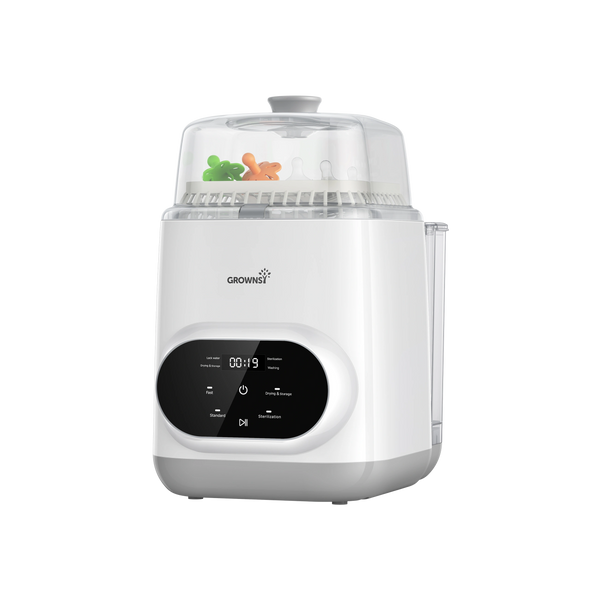
This is why a baby bottle sterilizer and dryer is a superior choice. These machines run a drying cycle immediately after steaming, often pulling air through a HEPA filter to block dust. The bottles go from dirty to sterile and bone-dry without you ever touching them or exposing them to kitchen air.
You can leave the bottles inside the machine until you are ready to use them. As long as the lid remains closed, the environment inside remains sterile for up to 24 hours. This "storage" feature provides immense peace of mind, knowing that the bottle you grab at 3:00 AM is perfectly clean.
When Can You "Let Go"? How to Safely Stop Daily Sterilizing
The rigorous daily routine of sterilization can later be eased. The sense of when to call a halt depends on your child's development.
- 3-Month Milestone: For a healthy, full-term child, most pediatricians recommend that daily sterilization is no longer necessary once the child surpasses the three-month age milestone. This is because, at this stage, their immunity level is stronger, and the acid in their stomach is capable of better fighting bacteria.
- The Mobility Factor: Now that your child is venturing out with his hands and mouth, your environment is no longer a germ-free zone. When your child begins to lick the floor, chew on his toys, or put his hands into his mouth, it is not as effective to sterilize his bottles.
- Water Quality: If your household obtains water from a well or an unknown water supply, you need to continue sterilizing longer than a person on a treated municipal water supply.
Once you stop sterilizing, merely washing your bottle with hot, soapy water, as well as a bottle brush, is enough. It is still a useful exercise, though, to run a sterilization cycle every week or when your child has been ill.
FAQ about Bottle Sterilizers
Do I still need to wash the bottles before putting them in a sterilizer?
Yes, for most standard machines. Steam kills bacteria but won't clean out the milk solids or formula residue. This has to be washed out with soap and water. But if you buy a top-of-the-line bottle washer and sterilizer, that takes care of the entire procedure.
Can I use vinegar to descale my sterilizer?
Yes, regular descaling is necessary in order to remove minerals that have accumulated on the heating plate (limescale). The most common practice is a mixture of white vinegar and water, which is run in a cycle (emptying the bottles), soaked, and rinsed. The exact vinegar-to-water ratio depends on the sterilizer model. Always follow the manufacturer's instructions.
Can I sterilize other items besides bottles?
Absolutely. The typical items that most units are capable of handling are pacifiers, parts for a breast pump, and teething toys. In essence, anything that is made from hard plastics and/or silicone, which is described as "heat safe" or "boil safe," is a potential candidate to go inside the sterilizer.
How often should I replace the water in the sterilizer?
You need to add fresh water with every single use. This is because old water may harbor minerals that might result in mineral buildup, as well as bacteria from the previous use. You need to dump all the remaining water, dry the heating plate, and add clean water with the next use.
Does microwave steam sterilization work as well as electric machines?
Yes, microwave bags or containers work efficiently in killing bacteria. The most discouraging part is that they do not have a drying mechanism. This means the bottles are damp when they come out, with the need for air-dried storage, thereby resulting in a potential chance of a re-contamination threat described earlier. They are ideal for travel but not ideal for use at home.


